Design16 min read
Lace Wedding Invitations: Vintage Ideas & Wording to Copy
Chantilly, Alençon, guipure: what each lace says, lace on paper or on screen, vintage styles from Victorian to the 1950s, palettes and wording to copy.
By The Veiloria AtelierPublished Updated
Contents
- Why lace is the most bridal of all materials
- Six laces and the invitation each one suits
- Lace on paper: five ways, and what each costs you
- Lace on screen: when the lace opens
- Matching the invitation to the gown
- Vintage wedding invitation styles by era
- Palettes: ivory, champagne, blush and pearl
- Vintage wedding invitation wording to copy
- Pitfalls: when vintage turns into costume
- Paper or digital lace: an honest comparison
- Sources
- Frequently asked questions
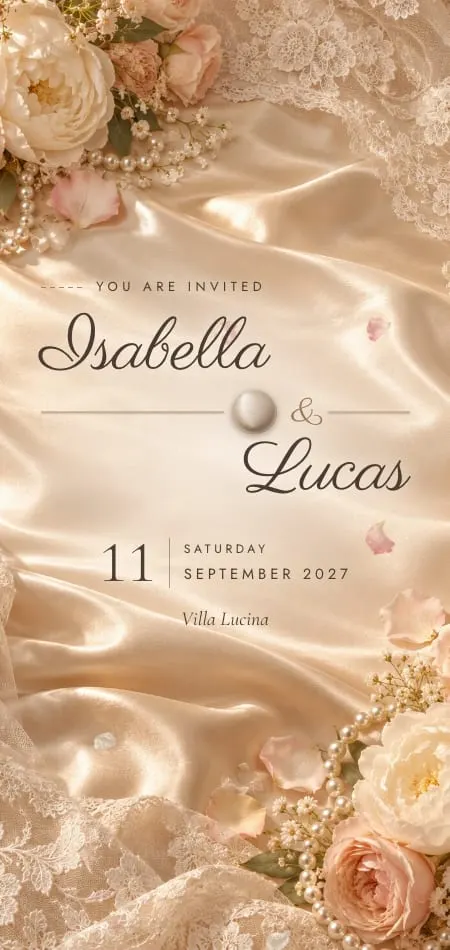
Lace wedding invitations borrow the most bridal material there is: the lace of the gown and the veil. On paper, lace arrives as laser-cut card, wraps, sleeves and lined envelopes; on screen, it can open, as in our Dentelle design, where guests undo the pearl buttons of a lace gown. Choose the lace by the feeling of your day: Chantilly for soft romance, Alençon for formal couture, guipure for something bold and modern.
Below: why lace is so bridal, six laces compared, lace on paper and on screen, matching the gown, vintage styles by era, palettes, wording to copy and the mistakes that turn vintage into costume.
Why lace is the most bridal of all materials
Lace says "bride" before a single word is read. It is the material of the veil, the bodice and the heirloom handed down, and for two centuries it has been the one fabric guests expect to see at a wedding.
The white dress and the lace arrived together. The Victoria and Albert Museum notes that by 1800 it had become usual for a bride to wear white or cream, and that Queen Victoria helped popularize white when she married in 1840 in a simple ivory satin dress, trimmed with English Honiton lace. The V&A's own wedding dress of 1865 is white satin edged with Honiton lace, with a deep flounce of bobbin lace at the hem: the Victorian bride in one object. A century later, in 1956, Grace Kelly married in a bodice of rose point, a 19th-century Brussels needle lace, touched with seed pearls; the Philadelphia Museum of Art holds the dress.
Lace also carries time you can see. UNESCO, which listed Alençon needle lace as intangible cultural heritage in 2010, records that it takes about seven hours to make one square centimeter. When an invitation borrows lace, it borrows that sense of hours spent on one thing.
This is what lace looks like when it can move. In Dentelle, the screen is the back of a wedding gown in ivory Chantilly lace over champagne satin. Guests touch it, the silk-covered buttons come undone one after another from top to bottom, and the lace parts like the gown opening onto a bridal still life of silk, peonies and pearls, where your names appear.
Our demo couple, Isabella and Lucas, marry at a villa in Tuscany, black tie. Their story explains the buttons: Isabella's grandmother sewed her own wedding dress by hand, and sixty years later its lace has been sewn into a new gown with the same twenty-two buttons. Lace trims and loose pearls run through every section that follows.
Six laces and the invitation each one suits
Handmade lace comes in two families, and machines reproduce both. Needle lace is built stitch by stitch with a needle and a single thread; bobbin lace is woven from many threads wound on bobbins; machine lace, made on Leavers looms since the 19th century, imitates either. Bridal shops still use the old names as shorthand for a look, and each look suits a different invitation:
| Lace | How it is made | The look | Era and feeling | The invitation it suits |
|---|---|---|---|---|
| Chantilly | Silk bobbin lace, today mostly machine-made | A delicate net with flowers outlined in a heavier thread | Second Empire and Belle Époque; soft, romantic | Script names, ivory and champagne, plenty of air. Dentelle is Chantilly |
| Alençon | Needle lace from Normandy | Motifs on a fine net with a raised, corded outline | French court to haute couture; formal | A lace border framing an engraved serif, symmetry, black tie |
| Calais-Caudry (Leavers) | Machine lace woven on Leavers looms in northern France | Supple and fine, from airy florals to dense allover patterns | Today's couture gowns; modern classic | One lace motif, a clean layout, generous margins |
| Guipure | Motifs joined by bars, with no net behind them | Bold, heavy flowers and geometry | 1960s mod to modern boho; confident | One strong cut-out motif, a short text, a single deeper color |
| Venetian (gros point) | Raised needle lace, first made in Venice | Deep, carved-looking scrolls and flowers | Baroque, 17th century; grand | Ornate and ceremonial: a church or palazzo, gilt. Serenissima is Venice |
| Bruges and Belgian bobbin lace | Bobbin lace from Flanders | Tape-like flowers linked by plaited bars | Heirloom; a grandmother's veil | Family and memory: a story section, an old photograph, a wax seal |
The museum records add color. The V&A describes Chantilly's "delicate net ground", first worked in white or "blonde" silk, then in black, fashionable into the 1860s. Its gros point de Venise was the most fashionable lace from the 1660s to the 1680s, for men as much as women. And it holds "Kate's Lace" from Sophie Hallette in Caudry, woven on English Leavers looms: a 1958 pattern chosen for the Duchess of Cambridge's wedding dress.
Lace on paper: five ways, and what each costs you
On paper, lace is cut, wrapped or printed, and each technique has a charm and a catch. If you are choosing a printed suite, this is the honest list:
| Technique | What guests see and feel | The catch | The digital equivalent |
|---|---|---|---|
| Laser-cut lace card | A pocket or overlay cut into lace | Fine bridges tear; the cut-out can sit over the words | Lace drawn in layers that move aside |
| Lace wrap or sleeve | Real or printed lace around the card | Bulky, heavier to post, crushed in transit | An opening the guest unwraps |
| Lace belly band | A band of lace ribbon around the suite | Slips off in the mail; one more piece to assemble | A ribbon the guest pulls, as in Ruban |
| Lace-lined envelope | A lace pattern printed inside the envelope | Seen for a second, then torn | An envelope with your initials, the first thing guests see |
| Printed lace (foil, letterpress, white ink on vellum) | Lace as a pattern on the card itself | Low contrast on ivory paper | A lace border or texture behind the text |
If you love paper lace, keep it to one piece. A lace-lined envelope or a single laser-cut overlay is elegant; two lace techniques in the same suite already look busy.
Lace on screen: when the lace opens
On a screen, lace can do what paper cannot: move, part and open. A digital lace invitation keeps what lace means and drops what makes it fragile: no torn bridges, no crushed sleeves, no postage, and the same opening for the cousin abroad as for the aunt next door. Judge one by three rules:
- One gesture, then stillness. In Dentelle the buttons come undone, the lace parts, and the page then holds still to be read.
- Lace frames; it never covers. If lace crosses the date or the address, decoration has won over information.
- The material looks real. A fine net and flowers with weight are the difference between a design and clip art.
Our guides to animated wedding invitations and luxury digital wedding invitations explain what makes an opening feel like stationery rather than a slideshow.
Matching the invitation to the gown
Match the invitation to the gown's mood and material, not its exact pattern. Many brides keep the dress a secret until the aisle, so the invitation should hint, not reveal: borrow the feeling of the lace, never a photograph of it.
| If the gown is | Let the invitation be | Details that echo it | A design that carries it |
|---|---|---|---|
| All-over lace | Lace as the opening or the border, on ivory | Pearl buttons, scalloped edges | Dentelle |
| Smooth satin or crepe | No lace at all: a smooth ivory ground | A wax seal, letterpress, one fine line | Cachet |
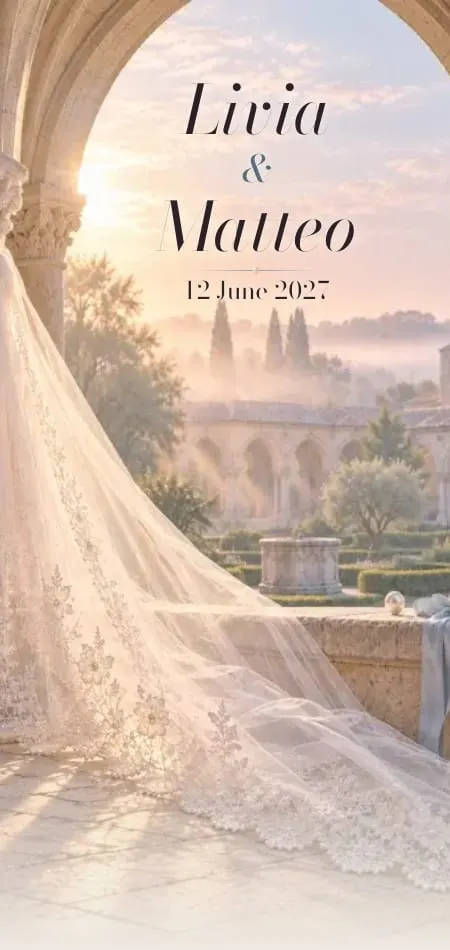
| Tulle with a long veil | Translucent layers, something lifted | A veil, a single pearl | Cathédrale |
| Pearls and beading | A pearl palette and one pearl detail | A pearl pin, a row of buttons | Dentelle or Cathédrale |
| Boho lace or guipure | Pressed flowers on cotton paper | Wildflowers, typed labels | Herbier |
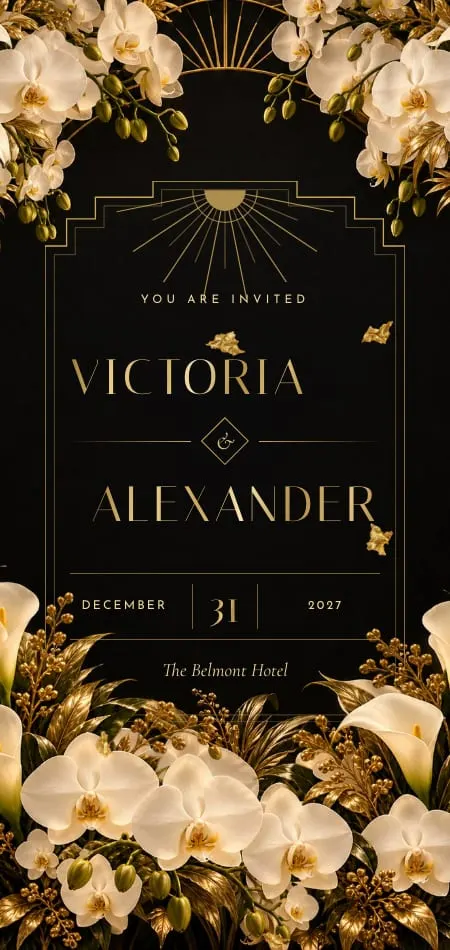
| A sleek black-tie column | Black and gold, with the lace left to the veil | Gold foil, a monogram medallion | Soirée |
In Cathédrale, guests lift a cathedral-length veil with a fingertip: three layers of tulle fly off over a cloister at dawn, and one pearl slips from the lace and comes to rest beside your date. It is the design for a bride whose veil matters more than her gown. For the dress code line, including the polite way to keep white and ivory for the bride, see our guide to the dress code on a wedding invitation.
Vintage wedding invitation styles by era
"Vintage" is not one style but five, each with its own lace, palette and wording. Choose the era that suits your venue and gown, then let one design carry it.
| Era | Hallmarks | Lace and palette | Wording register | Designs that carry it |
|---|---|---|---|---|
| The 18th-century salon | Toile de Jouy, pastoral scenes, gilt frames | Fine needle lace; rose, cream and gilt | Courtly and formal | Toile |
| Victorian (1837–1901) | Love letters, pressed flowers, wax seals, collections | Honiton and Chantilly; ivory, faded violet, oxblood | Formal; the bride's parents host | Herbier, Billet Doux, Porcelaine, Chapitre |
| Edwardian (1901–1910) | White on white, high lace collars, long veils, pearls | Chantilly and tulle; ivory, pearl, champagne | Gentle and formal | Dentelle, Cathédrale |
| The 1920s | Art Deco geometry, cap veils, ropes of pearls, evening parties | Lace over silk; black, gold, ivory | Short and chic: "dinner and dancing to follow" | Soirée, Minuit |
| The 1950s | Lace bodices over full skirts, seed pearls, the formal stationer's suite | Alençon and Brussels lace; champagne, ivory, blush | Engraved formality: "request the honour of your presence" | Dentelle, Cachet |
The Victorians: letters, flowers and collections
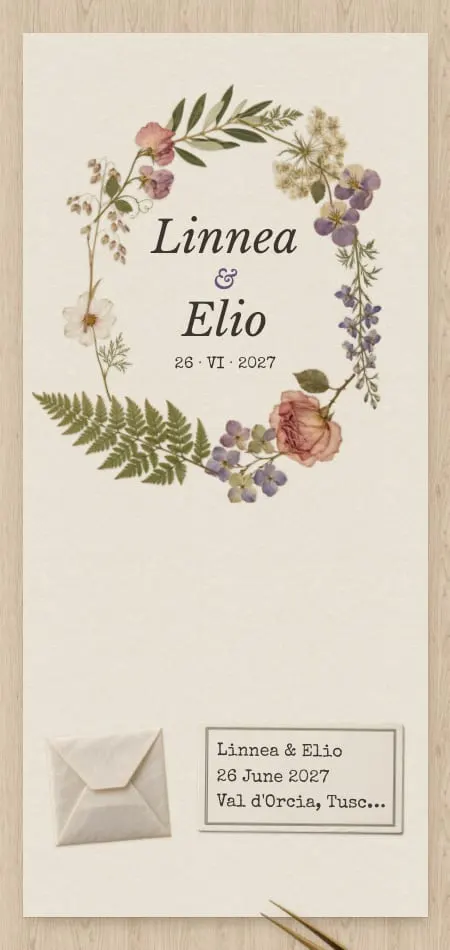
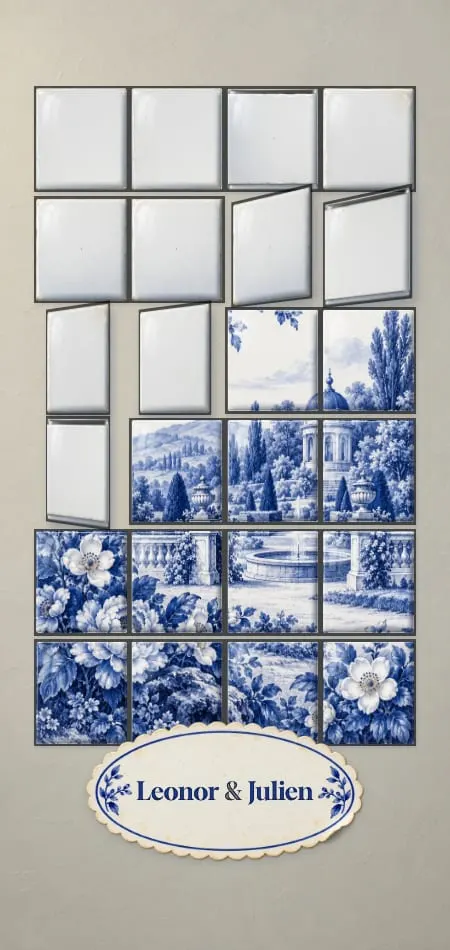
The Victorian wedding was sentimental and handwritten. In Herbier, guests slip the leather straps off a flower press and a herbarium sheet rises, its label typing your names. Billet Doux is a love letter in handmade parchment, sealed with apricot wax and a dried rosebud. Porcelaine is a collector's cabinet of blue-and-white china, and Chapitre a green morocco book whose title page sets itself line by line. For the meanings Victorians gave each flower, see floral wedding invitations.

Edwardians and the 1950s: white on white
Both eras dressed the bride in lace over silk and finished her with pearls, which is exactly Dentelle's palette. For the 1950s, add Cachet, a Paris stationer's finest suite: guests press an oxblood wax seal, it cracks in two and the letterpress card rises. For a quieter, heritage-house version of the same restraint, see old money wedding invitations.
The 1920s and the salon
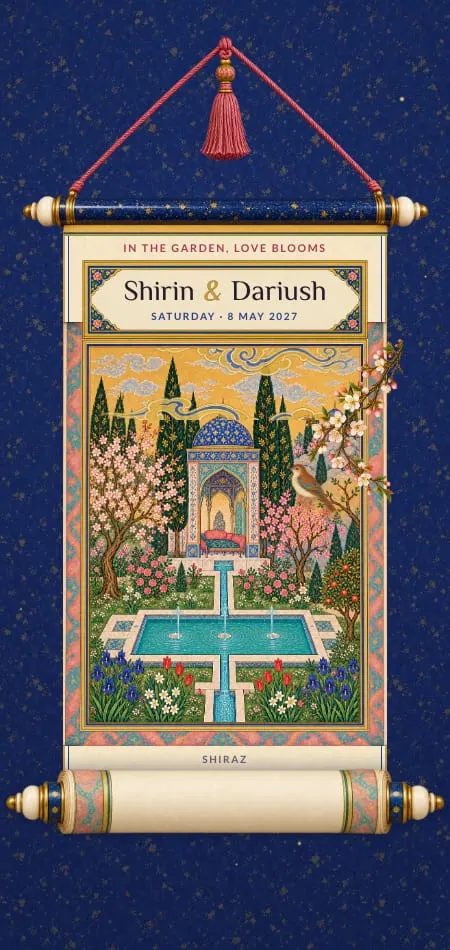
The 1920s brought black, gold and geometry into the evening: Soirée is a black pochette whose four flaps release in a spiral, each flashing its gold-foil lining. Before them all, the 18th-century salon lives in Toile, where a painted screen folds back and the little rose-printed figures on the walls begin to move.
Palettes: ivory, champagne, blush and pearl
A lace palette is a family of near-whites with one deeper ink for the words. These four start where lace does; the hex values are starting points to give your designer, not rules:
| Palette | Ground | Accent | Ink for the text | Mood | Where to see it |
|---|---|---|---|---|---|
| Ivory and antique gold | Ivory #FAF5EE | Antique gold #C2A27A | Warm brown #4B3B30 | Couture, timeless | Dentelle |
| Champagne and nude | Champagne #E6D3BC | Nude #C9AE8F | Warm brown #4B3B30 | Evening, black tie | Dentelle's demo dress code |
| Blush and old rose | Blush #F2E1DC | Old rose #B98A8E | Plum brown #5B4146 | Romantic, garden | Toile, Roseraie |
| Pearl and dove grey | Pearl #F4EDE3 | Dove grey #B9A9A0 | Charcoal #3F3A38 | Ethereal, morning | Cathédrale |
Two rules keep a pale palette elegant. Set the text in a dark, warm ink, never gold or champagne on cream for anything smaller than the names. And let one color step forward: an old rose, a French blue, a black. For "something blue" beside your lace, see dusty blue wedding invitations; for every palette by season, wedding invitation colors; for more designs in this soft register, romantic wedding invitations.
Vintage wedding invitation wording to copy
Vintage wording is formal in a few precise ways: dates and times spelled out, no abbreviations, "honour" for a ceremony in a place of worship and "pleasure" elsewhere. The traditional British spelling, "honour" and "favour", is kept even on American formal invitations. Names in brackets are yours to fill.
The Victorian formal, the bride's parents hosting:
Mr and Mrs [Parents' names]
request the honour of your presence
at the marriage of their daughter
[Bride's first and middle names]
to
Mr [Groom's full name]
on Saturday, the fifth of June
two thousand and twenty-seven
at four o'clock in the afternoon
[Church], [Town]
The Edwardian, both families, written for our Dentelle demo couple:
Together with their families
Isabella and Lucas
request the honour of your presence at their wedding
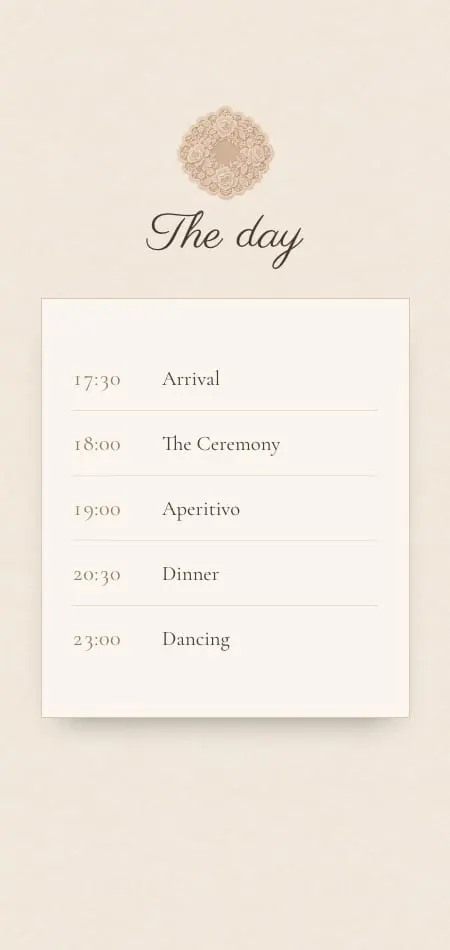
on Saturday, the eleventh of September, two thousand and twenty-seven
at six o'clock in the evening
Villa Lucina, Montalcino, Tuscany
The 1920s evening:
The pleasure of your company is requested
at the marriage of [Name] and [Name]
on Friday, the thirty-first of December
at half past seven o'clock
[Venue], [City]
Dinner and dancing to follow · Black tie
The 1950s reception card:
Reception immediately following the ceremony
[Venue]
The favour of a reply is requested by the first of August
Modern phrases translate into the vintage register like this:
| Modern | Vintage register |
|---|---|
| Join us for our wedding | Request the pleasure of your company |
| Sept 11, 2027, 6 pm | The eleventh of September, two thousand and twenty-seven, at six o'clock in the evening |
| RSVP by Aug 1 | The favour of a reply is requested by the first of August |
| Party to follow | Reception immediately following |
| Dress: formal | Black tie |
| Yes / No | Joyfully accepts / Regretfully declines |
| White is for the bride | Ivory and white are kept for the bride |
A Victorian verse for the back of the card: "How do I love thee? Let me count the ways." (Elizabeth Barrett Browning, Sonnets from the Portuguese, XLIII, 1850). More in love quotes for wedding invitations; every host combination in wedding invitation wording; church conventions in religious wedding invitation wording. An heirloom detail, like Isabella's grandmother's lace, belongs in the story section: see how to write your love story.
Pitfalls: when vintage turns into costume
Vintage fails by piling up, not by lacking. These are the mistakes we see most:
- Too many textures. Lace, burlap, kraft paper, twine and wood slices in one suite. Choose one hero material and let the rest be plain.
- Script you cannot read. Calligraphy is for names. Times, addresses and the reply date belong in a readable serif, at a size a grandparent can read without glasses.
- Sepia overload. Sepia photographs on parchment in brown ink under an "aged" filter look like a museum label. Keep white space and one fresh color.
- Pale on pale. Champagne text on ivory, or gold on cream, disappears on a phone in daylight.
- Lace over the words. An overlay or a frame that crosses the date is decoration winning over information.
- Fake ageing. Coffee stains, torn edges and scratched "vintage" textures are a costume, not a period.
- Archaic wording. Vintage is formal, not medieval: no "thee" and "thou" in the invitation itself.
- Spoiling the dress. A photograph of the gown's lace on the invitation tells every guest what the aisle should reveal.
The test: open the invitation on a phone at half brightness and read the date from arm's length. If you cannot, the vintage is winning.
Paper or digital lace: an honest comparison
Paper lace can be held; digital lace can open, travel and change. Neither is wrong, and many couples do both.
| Paper lace suite | Digital lace invitation | |
|---|---|---|
| Touch | Real lace or cut paper in the hand | Lace that opens on screen, not to the touch |
| Keepsake | Kept on a mantelpiece | At Veiloria, online for at least 12 months after the wedding |
| Cost as the list grows | More cards, wraps and stamps | At Veiloria, one payment for unlimited guests |
| Fragility | Cut lace tears, sleeves crush | Nothing to crush |
| Changes after sending | A reprint | Free, on the same link |
| Replies | Reply cards posted back | Built-in RSVP, as they arrive |
| Guests abroad | Weeks in the post | The same moment as everyone else |
At Veiloria, a hand-designed invitation costs $199 (Essential), $599 (Premium) or $999 (Bespoke), paid once, for unlimited guests, or the equivalent in your currency. Premium redesigns it around your wedding, in your colors, with a matching Save the Date. Bespoke begins on a blank page with your own designer, so your gown's lace or your grandmother's veil can be its starting point, and it can recreate a paper suite you already have. If a few grandparents would treasure real lace, print a small run for them and send everyone else the link; digital vs paper wedding invitations weighs the rest.
Keep reading: wedding invitation trends · romantic wedding invitations · floral wedding invitations · old money wedding invitations · wedding invitation colors · wedding invitation wording
Sources
- Victoria and Albert Museum, Wedding dress, England, 1865: white satin trimmed with Honiton lace; brides wore white or cream by 1800; Queen Victoria popularized white in 1840. Checked 28 October 2026.
- Victoria and Albert Museum, Shawl, Chantilly silk bobbin lace, 1860–1870: Chantilly's net ground and outlined pattern; white, blonde and black silk lace. Checked 28 October 2026.
- Victoria and Albert Museum, Border, Alençon needle lace, Cravat, gros point de Venise, Scarf, Bruges bobbin lace and "Kate's Lace", Sophie Hallette. Checked 28 October 2026.
- UNESCO, The craftsmanship of Alençon needle lace-making, inscribed 2010: about seven hours per square centimeter. Checked 28 October 2026.
- Philadelphia Museum of Art, Grace Kelly's Wedding Dress and Accessories, 1956: rose point, a 19th-century Brussels needle lace, with seed pearls. Checked 28 October 2026.
Frequently asked questions
What are lace wedding invitations?
Lace wedding invitations use lace, or the look of lace, as their main material: a laser-cut paper overlay, a lace wrap or belly band, a lace-lined envelope, or lace printed on the card. A digital lace invitation draws the lace on screen, where it can open; in Veiloria's Dentelle, guests undo the pearl buttons of a lace gown to reveal your names.
Are lace wedding invitations still in style?
Yes, because lace never left bridal fashion; what has changed is how much of it couples use. What we are designing most is one lace detail on an ivory or champagne ground with clean, readable type, rather than a whole suite wrapped in lace. Our guide to wedding invitation trends covers the rest of the season.
Can a digital wedding invitation have lace?
Yes. A digital invitation can render lace in fine detail and make it move: in Dentelle, ivory Chantilly lace over champagne satin parts as the buttons come undone, and lace trims and pearls run through every section. Nothing tears in the post, and every guest receives the same opening from one link.
What colors go with lace wedding invitations?
Ivory, champagne, blush and pearl grey are the natural lace palette, finished with antique gold. Set the text in a dark, warm ink such as brown or charcoal so it stays readable, and add one deeper color, like old rose or French blue, if the palette feels too pale.
What is the difference between Chantilly and Alençon lace?
Chantilly is a bobbin lace: a delicate, sheer net with flowers outlined in a heavier thread, soft and romantic. Alençon is a needle lace from Normandy with a raised, corded outline, crisper and more formal. On an invitation, Chantilly suits script names and soft palettes; Alençon suits engraved serifs and symmetrical borders.
How do you word a vintage wedding invitation?
Write it in full: dates and times spelled out ("the eleventh of September at six o'clock in the evening"), no abbreviations, and "request the honour of your presence" for a ceremony in a place of worship or "the pleasure of your company" elsewhere. End with "The favour of a reply is requested by" and a date, and keep the names in calligraphy and everything else in a readable serif.