Inspiration15 min read
Old Money Wedding Invitations: The Quiet-Luxury Rules
The old-money look decoded as stationery rules: the palette, engraving, a crest instead of a photo, formal wording to copy by host, what never appears and the digital version.
By The Veiloria AtelierPublished Updated
Contents
- What "old money" means on a wedding invitation
- The palette: ivory, black ink and one quiet color
- Engraving, letterpress and the materials that do the talking
- A crest or monogram instead of a photograph
- The wording rules
- American and British conventions
- Formal wording templates to copy, by host
- What never appears on an old-money invitation
- The digital version, without losing the register
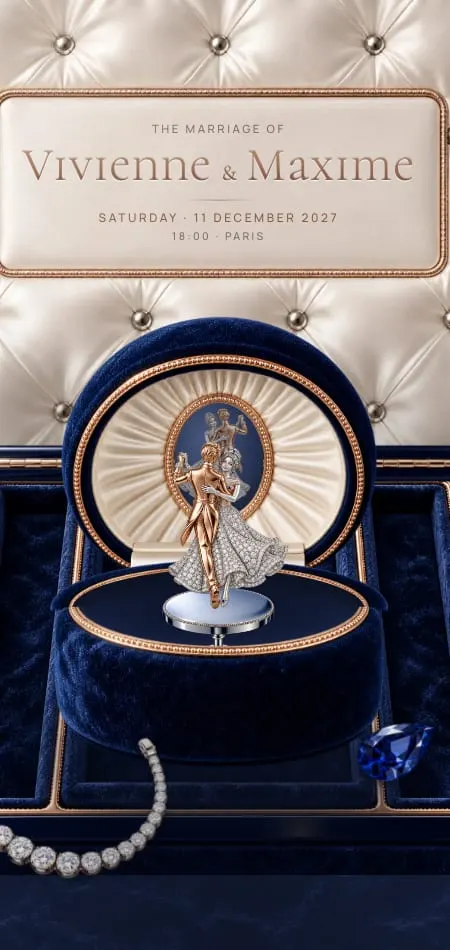
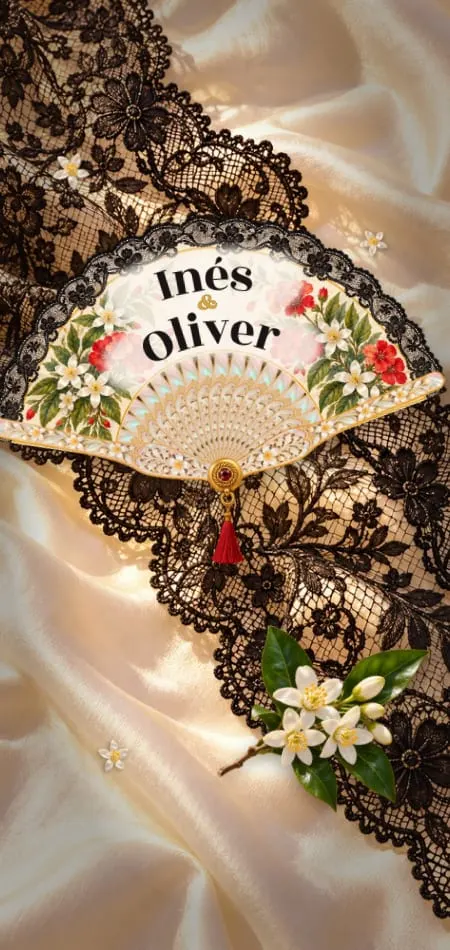
- Seven designs with the old-money register
- Sources
- Frequently asked questions
Old money wedding invitations follow the oldest rules of formal stationery: ivory or white card, black ink, engraving or letterpress, a crest or monogram where a photograph would be, and third-person wording with every date and time spelled out. What makes them look expensive is what they leave out: no registry, no emoji, no trend fonts, nothing that flashes.
Below: what old money means on paper, the palette and materials, the wording rules with templates to copy by host, what never appears, the digital version, and seven designs that keep the register.
What "old money" means on a wedding invitation
An old money wedding invitation is one that could have been sent in 1957 or in 2027: formal stationery that follows the rules rather than the season. The phrase comes from fashion, where quiet luxury means the money is in the cloth, never in the logo. The invitation it describes is older than the phrase: the formal invitation as fine stationers and etiquette books have always set it.
Three things define it:
- Restraint. One ink, one script, one serif, one ornament. The card holds still.
- Material over decoration. Cotton paper, engraved or letterpress type, a lined envelope.
- Etiquette. Hosts named in full, the third person, every number in words, nothing about gifts.
The test we use in the atelier: if a detail would date the invitation to this year, leave it out. This guide is about the look and its etiquette; for what makes any invitation feel luxurious on a screen, read our guide to luxury digital wedding invitations.
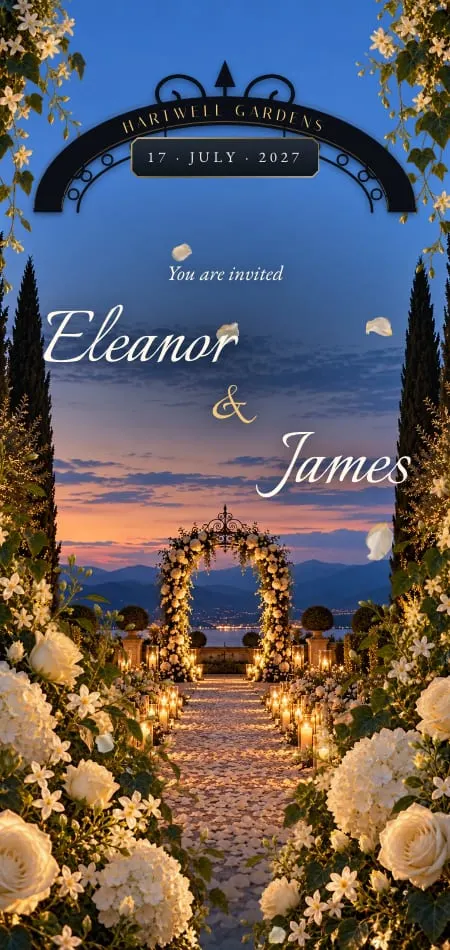
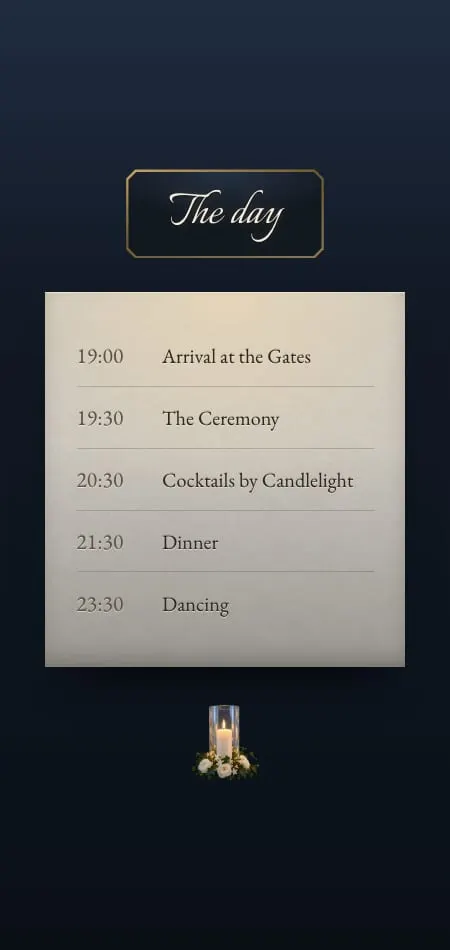
Portail is the old-money garden wedding in one gesture: black wrought-iron gates woven with white roses, jasmine and ivy, tied shut with satin. Guests touch the knot, the gates swing open, and the view walks down an aisle of petals and candles to an arch of white flowers where the names glow. Our demo couple, Eleanor and James, request the pleasure of your company in a white garden by candlelight, with an evening dress code in deep greens and navy. No photograph on the cover, no glitter, and only one thing moves: the gates.
The palette: ivory, black ink and one quiet color
Old money colors are the colors of paper and ink: ivory, cream or white card, black ink, and at most one deep accent such as navy, hunter green or burgundy. Crane & Co., the American cotton-paper stationer, says formal invitations are traditionally printed on ecru (cream, ivory, eggshell) or white paper, and the Emily Post Institute recommends the same papers for a formal wedding.
| Color | Where it goes | What it says | Where to see it |
|---|---|---|---|
| Ivory, cream, ecru | The card itself | The classic formal paper | Cachet's cotton suite |
| Black | All the type | The most formal ink there is | Every formal invitation |
| Navy | Ink, envelope lining, the monogram | Naval, collegiate, coastal | Carré's silk |
| Hunter green | Lining, wax seal, a book cloth | The country house, the library | Chapitre's morocco binding |
| Burgundy, oxblood | Wax seal, monogram, ribbon | The cellar, the leather armchair | Cachet's oxblood seal |
| Gold | A hairline edge, a foil monogram | Candlelight, used once | Soirée's gold medallion |
Handle gold with the most care: a gilt edge or a foil monogram reads old money; glitter and metallic gradients do not. For the black-tie end of the palette, see black and gold wedding invitations; for every combination, wedding invitation colors.
Engraving, letterpress and the materials that do the talking
Engraving is the old-money printing method: type struck from a metal die, raised on the front and pressed into the back. Crane still treats engraving in black ink as the formal standard and gives a simple test: turn the card over, and if you can feel the dent of every letter, it was engraved.
| Method | What it looks like | Formality |
|---|---|---|
| Engraving | Raised, crisp ink, a dent on the back | The most formal |
| Letterpress | Type bitten into soft cotton paper | Formal, warmer, artisanal |
| Thermography | Raised ink made with powder and heat, no dent | Imitates engraving for less |
| Flat printing | Ink on the surface | Correct on heavy paper with good typography |
The finish matters as much as the print. Crane notes that double envelopes remain the standard for formal invitations, the inner one carrying only the guests' names, and lists the embassy size, 7½ × 5½ inches, as a classic. For type, the Emily Post Institute suggests a script for the names and a readable serif for the details.
A crest or monogram instead of a photograph
The formal invitation carries no photograph: its ornament is a crest, a monogram or nothing at all. Photographs are welcome on the save the date and the wedding website; the invitation is about the occasion, not the faces. If you want them somewhere in the suite, our guide to wedding invitations with photos shows where they fit.
Four options, from grandest to quietest:
- A family crest, used honestly. A coat of arms belongs to the family entitled to it. If yours bears one, it sits engraved or blind-embossed at the head of the card. Never buy a "surname crest" online.
- A wedding monogram. Your initials, or a cypher, at the head of the card and repeated on the envelope flap, the reply card and the wax seal.
- Your venue, drawn. A fine-line drawing of the house or the chapel, like an engraved vignette.
- Nothing. The most old-money ornament of all is a generous blank margin.
At Veiloria, the envelope every guest opens first carries your initials on every plan. A personalized monogram, used across the invitation, is included with Premium and Bespoke and costs $29 on Essential (or the equivalent in your currency). On Premium, your real venue is painted by hand on the cover.
The wording rules
Old-money wording is formal wording kept strictly: hosts in the third person, full names, no abbreviations except Mr., Mrs. and Ms., and every number written in words. Most of these rules follow the Emily Post Institute's guide to formal wording:
- Speak in the third person. "Mr. and Mrs. Whitmore request…", never "We'd love you to join us".
- Honour or pleasure. "Request the honour of your presence" is for a ceremony in a house of worship; "request the pleasure of your company" is for every other venue.
- Keep the "u". Emily Post keeps the British honour even on American invitations, and favour follows on the reply line. Be consistent across the suite.
- Spell out the date and year. "Saturday, the twenty-ninth of May, two thousand twenty-seven": no "and" in the year, and only the day and month take capitals.
- Spell out the time. "At half after four o'clock" in the American engraved tradition, "half past" in British usage. Never "4:30 p.m.", and no "in the afternoon".
- No abbreviations. Street, Avenue, Saint and the state are written in full. Mr., Mrs. and Ms. stay abbreviated; Doctor is spelled out when it fits.
- Full names. Hosts with titles and middle names; the bride by her first and middle names when she shares her parents' surname; the groom in full, with his title.
- No dress code on the ceremony invitation. "Black tie" belongs in the lower right corner of a reception card.
- Nothing about gifts. No registry, and, strictly, not even "no gifts, please".
For 60 more examples, from divorced parents to two grooms, see our full guide to wedding invitation wording.
American and British conventions
American and British formal invitations share a register but differ in punctuation, dates and replies. Pick one convention and keep it throughout.
| American engraved tradition | British tradition | |
|---|---|---|
| Titles | Mr. and Mrs., with full stops | Mr and Mrs, no full stops |
| The request | "Honour" for a house of worship, "pleasure" elsewhere | "The pleasure of your company" is widely used for church weddings too |
| Date | Every word spelled out, year included | Often in figures ("Saturday 29th May") |
| Time | "at half after four o'clock" | "at half past four o'clock" |
| Guest's name | On the envelopes | Often handwritten at the top left of the card |
| Reception | A separate reception card | "and afterwards at…" on the invitation |
| Replies | A reply card and envelope | "RSVP" and an address, answered on the guest's own writing paper |
The handwritten name at the top left is the convention Debrett's describes for formal invitations, engraved or flat-printed on card.
Formal wording templates to copy, by host
Copy the template for your hosts, then change only the names, date, time and place. The examples borrow the first names of our Portail demo couple, Eleanor and James, and give them invented surnames. Each line break is a line on the card or the screen.
1. The bride's parents, a church ceremony
Mr. and Mrs. Charles Edward Whitmore
request the honour of your presence
at the marriage of their daughter
Eleanor Grace
to
Mr. James Alexander Hale
Saturday, the twenty-ninth of May
two thousand twenty-seven
at half after four o'clock
Saint Michael's Church
Stockbridge, Massachusetts
2. Both families, a garden or a country house
Mr. and Mrs. Charles Edward Whitmore
and
Mr. and Mrs. Richard Thomas Hale
request the pleasure of your company
at the marriage of their children
Eleanor Grace Whitmore
and
James Alexander Hale
Saturday, the twenty-ninth of May
two thousand twenty-seven
at half after four o'clock
Ashgrove House
Middleburg, Virginia
3. The couple hosting
The pleasure of your company
is requested at the marriage of
Eleanor Grace Whitmore
and
James Alexander Hale
…date and place as above
The passive form spares the couple from inviting guests in their own names: the most traditional way for a couple to host.
4. The British form
Mr and Mrs Charles Whitmore
request the pleasure of your company
at the marriage of their daughter
Eleanor
to
Mr James Hale
at Saint James's Church, Chipping Campden
on Saturday 29th May 2027
at half past four o'clock
and afterwards at Ashgrove House
RSVP
Ashgrove House, Chipping Campden, Gloucestershire
5. The reception card
Reception
immediately following the ceremony
Ashgrove House
Middleburg, Virginia
If the evening is black tie, those two words go in the lower right corner of this card, and only here. Our guide to the dress code on a wedding invitation explains each code.
6. The reply card
The favour of a reply is requested
by the first of May
M ……………………………………
accepts with pleasure
declines with regret
The "M" is not a typo: guests complete it as Mr., Mrs., Ms. or Miss before their names. With a reply card in the envelope, a bare "RSVP" on the invitation is unnecessary.
What never appears on an old-money invitation
What makes an invitation look old money is mostly what it leaves out. Each of these belongs somewhere, just not on the card:
| Never on the invitation | Why | Where it goes instead |
|---|---|---|
| Registry links or store names | The invitation asks for your presence, not presents | The wedding website, a gifts section, word of mouth |
| Cash or honeymoon-fund requests | Money is the one subject old money never prints | A discreet gifts section; see cash gift wording |
| Emoji, hashtags, exclamation marks | They date the card to one year and one phone | The group chat, after the wedding |
| Trend fonts | A bouncy brush script ages faster than anything | A classic script for names, a serif for the rest |
| A photograph on the cover | The card is about the occasion | The save the date, the website, a section further in |
| "Adults only" in capitals | Formal invitations say who is invited by naming them | The envelope, or a personal link that names each guest |
| A QR code on the face | It turns the card into a ticket | An enclosure card |
| Glitter, gradients, a watermark | Noise | Nowhere |
For what does belong, in order, see what to include in a wedding invitation.
The digital version, without losing the register
A digital invitation keeps the old-money register when it behaves like engraved stationery: private, quiet, correctly worded and made for one wedding. A purist will want paper for some guests; for everyone else, each element of the formal suite has an equivalent:
| Old-money element | On paper | On screen |
|---|---|---|
| The hand-addressed envelope | Each name written by hand | A personal link that greets each guest by name |
| The inner envelope | Names only, then the card | A private link, opened only by the people you send it to |
| Cotton card and engraving | Weight and the dent of every letter | Type set by a designer on a rendered paper ground |
| The wax seal | Pressed by hand, broken by the guest | An opening the guest performs: Cachet's oxblood seal, Portail's satin knot |
| The crest or monogram | Engraved at the head | Your monogram on the envelope and throughout |
| The engraved vignette | A fine-line drawing of the house | Your venue painted by hand on the cover |
| The reception card | A separate small card | A section for the reception, in your order |
| The reply card | "Accepts with pleasure / declines with regret" | A built-in reply: "Joyfully accepts / Regretfully declines" |
| One ink | Black, perhaps one color | One palette: no glitter, no gradients, no watermark |
Four things break the register on screen, however good the design:
- Sound that starts by itself. Music should start softly on the guest's first tap, with a mute button. On a Veiloria invitation, it plays only when your order includes music.
- Everything moving. Sparkles, confetti and a slideshow on one screen. One gesture, then stillness.
- A link dropped in a group chat. Send one personal message per household, the digital hand-addressed envelope. Our guide to digital wedding invitation etiquette has every rule.
- A casual note under a formal invitation. The message that carries the link should match the card:
Dear Mr. and Mrs. Ashby,
It would give us the greatest pleasure to have you with us on the twenty-ninth of May. Your invitation is at the link below, with every detail and a card for your reply.
With warm regards,
Eleanor Whitmore and James Hale
If a parent still finds a link too casual, our honest answer to are digital wedding invitations tacky covers the hybrid: an engraved run for the few who will keep one, the invitation for everyone else. Nothing is shared until you approve the proof, and on Bespoke we can recreate a printed suite you already have in digital, with your own domain included.
Seven designs with the old-money register
These seven designs from our collection keep the old-money rules: a material you could touch, one palette, one opening and room for formal wording. Each has a live demo and a matching Save the Date.

| Design | The old-money detail | Palette | Best for |
|---|---|---|---|
| Portail | Wrought-iron gates tied with satin open onto an aisle of candles | White roses, ivy, pale stone | Garden and estate weddings at dusk |
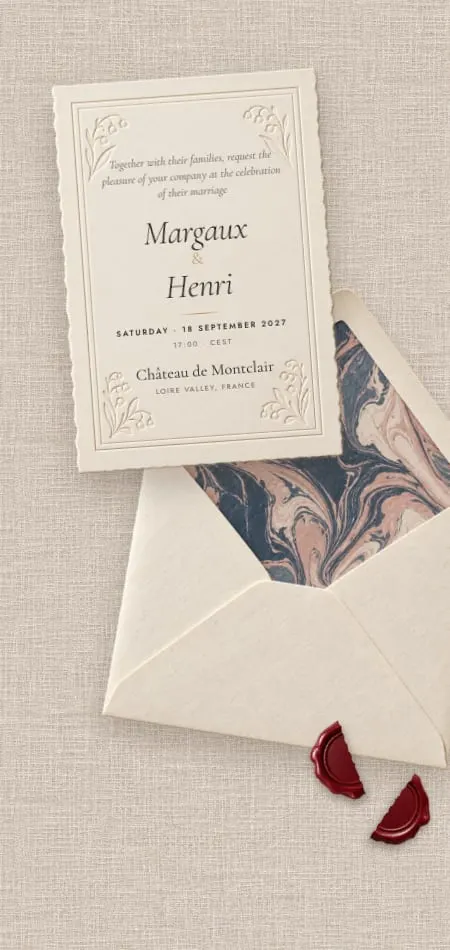
| Cachet | A Paris stationer's cotton suite: the oxblood seal cracks and the letterpress card rises | Oxblood and ivory | Purists who want engraved stationery |
| Chapitre | A green morocco book with a bookplate in your names and a steel-engraved plate of the venue | Leather and letterpress | Libraries, country houses, autumn |
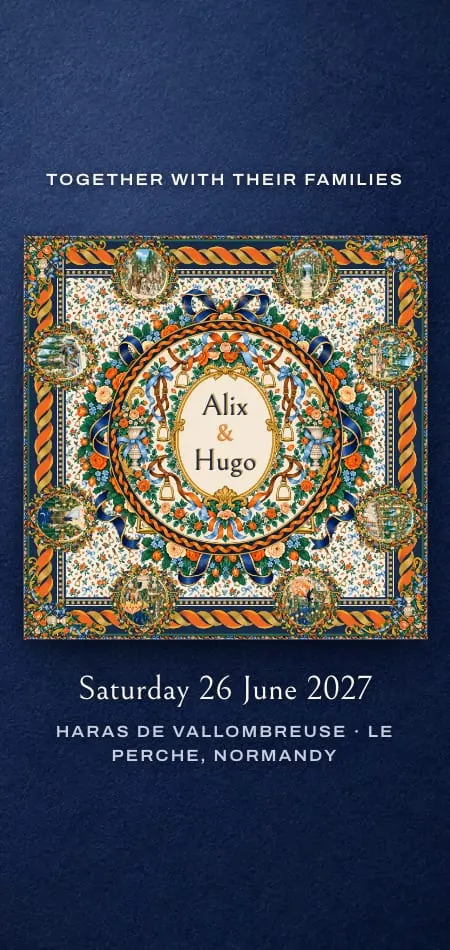
| Carré | A heritage silk carré composed for you two, untied from its twilly | Navy, orange, emerald | Couples who love a maison's craft |
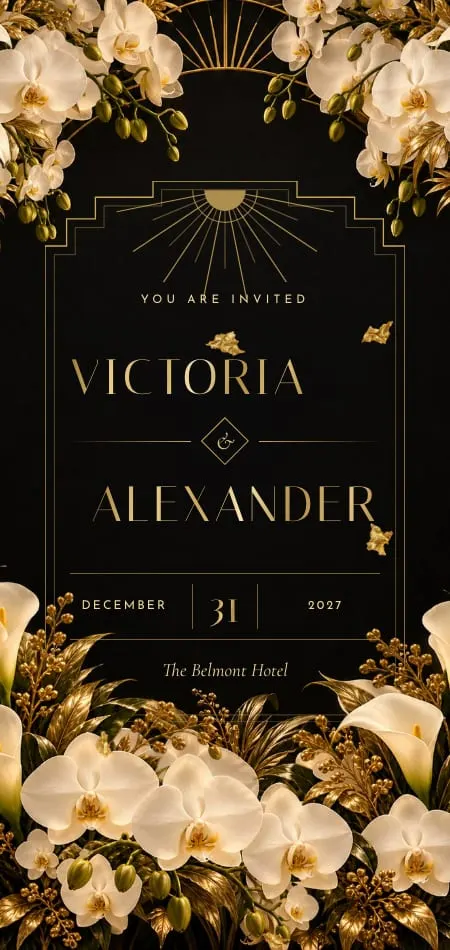
| Soirée | A black pochette sealed by a gold medallion with your initials | Black and gold foil | Black-tie evenings |
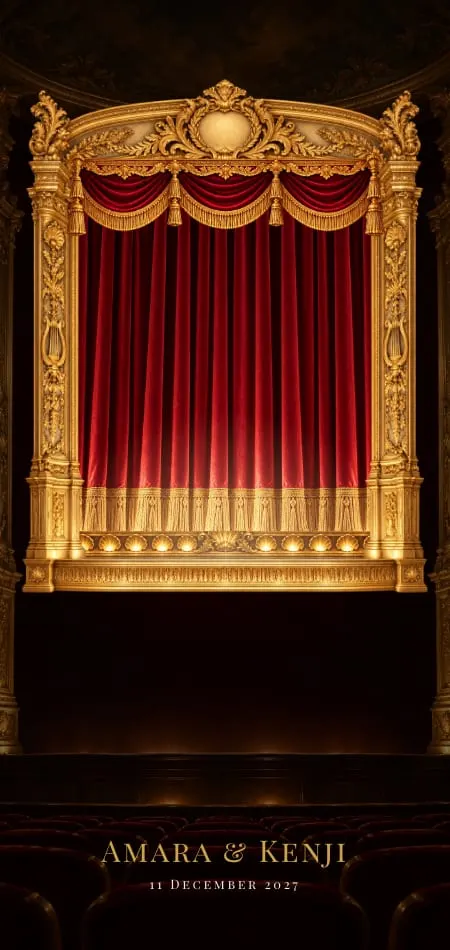
| Velours | An opera house: every moment of the day in its own gilded box | Crimson and gilt | Galas, theaters, evening receptions |
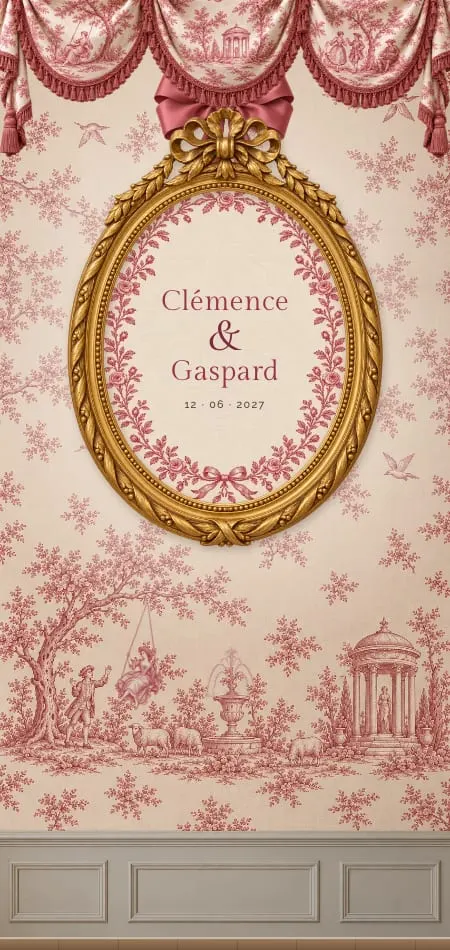
| Toile | A salon upholstered in rose toile, opened by a painted folding screen | Rose toile and gilt | Château gardens, daytime |
Portail and Toile are the garden-party end of old money; Cachet and Chapitre are paper and leather, the study after dark; Soirée, Velours and Carré are for evenings with a dress code. For more gardens, see floral wedding invitations; for something softer and more bridal, lace wedding invitations; to compare every opening, the most beautiful wedding invitations.
Sources
- The Emily Post Institute, Formal Wedding Invitation Wording, checked 28 October 2026: honour and pleasure, the British "u", dates spelled out with no "and" in the year, "half after", titles, RSVP and "black tie" placement.
- The Emily Post Institute, Choosing Your Wedding Invitation Style, checked 28 October 2026: cream, ivory or white paper for a formal wedding; a script for names, a serif for details.
- The Emily Post Institute, Wedding Invitation Dos and Don'ts, checked 28 October 2026: no registry or gift information with the invitation.
- Crane & Co., Choosing your Wedding Invitations, Post Script, 1 December 2025, checked 28 October 2026: ecru or white paper, engraving in black ink, the turn-it-over test, the embassy size, double envelopes.
- Crane & Co., Assembling the Invitation Enclosures, Post Script, 1 April 2017, checked 28 October 2026: reception and reply cards, tissues, assembly order.
- Debrett's, Addressing invitations, checked 28 October 2026: formal invitations engraved or flat-printed on card, the guest's name handwritten at the top left.
Frequently asked questions
What are old money wedding invitations?
Old money wedding invitations are formal invitations made the traditional way: ivory or white card, black ink, engraving or letterpress, a monogram instead of a photograph, and third-person wording with every number spelled out. What is left out (registry links, emoji, trend fonts) matters as much as what is printed.
What colors are used for old money wedding invitations?
Ivory, cream or white paper with black ink is the core, completed by one deep accent: navy, hunter green or burgundy. Gold appears once, as a gilt edge or a foil monogram, never as glitter.
Is it "honour" or "honor" on a wedding invitation?
Both are correct, but formal American invitations traditionally keep the British spelling, honour, as the Emily Post Institute does. Use "the honour of your presence" for a ceremony in a house of worship and "the pleasure of your company" anywhere else, and spell favour the same way on the reply card.
How do you write the date and time on a formal wedding invitation?
Spell everything out: "Saturday, the twenty-ninth of May, two thousand twenty-seven, at half after four o'clock." Capitalize the day and month but not the year, leave out the "and" in the year, and skip "in the afternoon". British invitations often say "half past" and may put the date in figures.
Can a digital wedding invitation look old money?
Yes, when it behaves like engraved stationery: a private, personal link for each guest, formal wording, one palette, a monogram rather than a photo, and an opening that moves once and then holds still. Some couples also print a small engraved run for the relatives who will keep one.
Should registry information go on a formal wedding invitation?
No. Formal etiquette keeps registry and gift information off the invitation and out of the envelope. Put it on your wedding website or in a gifts section of a digital invitation, and let family spread the word.