Design14 min read
Floral Wedding Invitations: 12 Flowers and What They Mean
Twelve wedding flowers and what the Victorians said they meant, roses by color, garden invitations by venue, how many flowers is too many, and garden wording to copy.
By The Veiloria AtelierPublished Updated
Contents
- What makes a floral wedding invitation feel considered
- The language of flowers, in two minutes
- 12 wedding flowers and what they mean
- Rose wedding invitations: what each color says
- Garden wedding invitations: let the venue choose
- Match the invitation's flowers to the bouquet and the season
- How many flowers is too many?
- Garden wedding invitation wording to copy
- Paper or digital for a floral invitation?
- Sources
- Frequently asked questions
The best floral wedding invitations choose their flowers instead of scattering them: one or two flowers that mean something to you, in season on your date, echoing the bouquet. In the Victorian language of flowers, ivy meant "fidelity, marriage", myrtle "love" and orange blossom "bridal festivities", while three modern favorites (peony, hydrangea and lavender) carried meanings you would never print.
Below: the language of flowers in two minutes, 12 flowers in one table, roses by color, garden invitations by venue, matching the bouquet and the season, how many flowers is too many, and garden wording to copy.
What makes a floral wedding invitation feel considered
A floral invitation feels considered when every flower on it was chosen for a reason: its meaning, its season, or because it will be in your hands on the day. Flowers added only to fill a corner read as decoration; flowers that recur from the invitation to the bouquet to the tables read as a wedding with a point of view.
Three questions decide it:
- What does it mean? Guests who know the language of flowers will read it.
- Is it in season? A peony invitation for an October wedding promises a bouquet the florist may struggle to deliver.
- Will it be there on the day? The invitation is where guests first meet your flowers; the bouquet and the tables are the rest of the story.
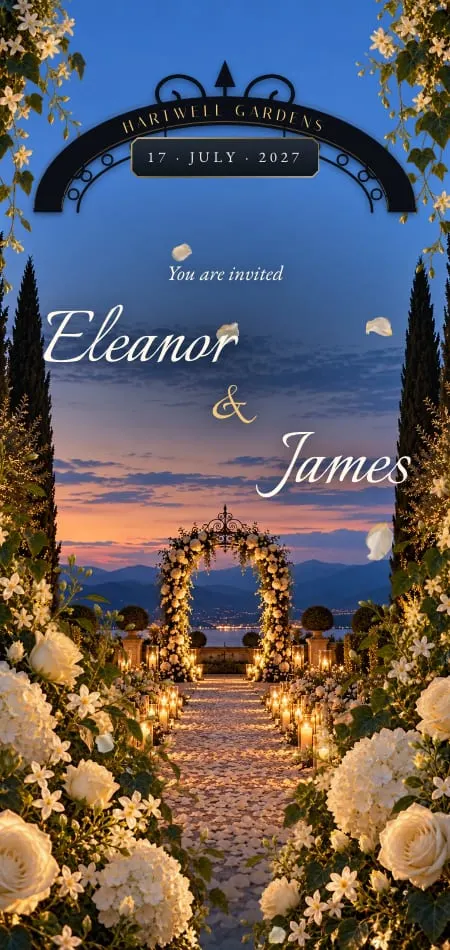
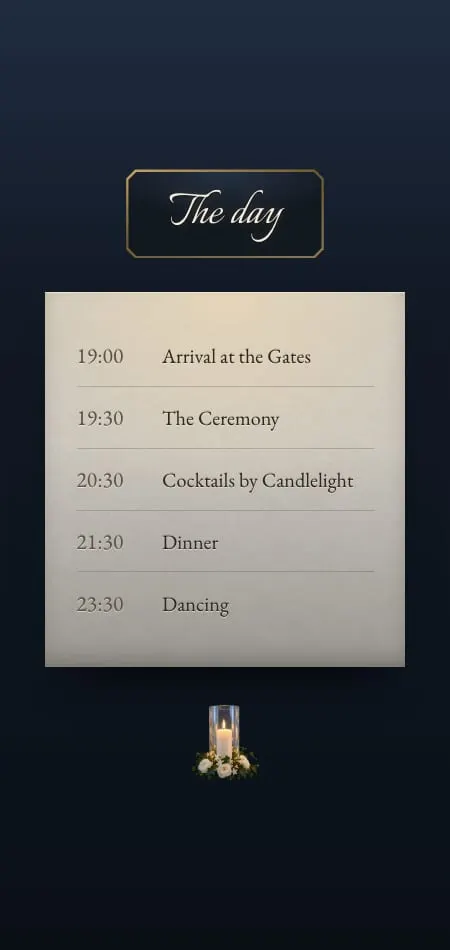
Our hero design shows the idea at its simplest. Portail uses three plants, each with a meaning: black wrought-iron gates woven with white roses, jasmine and ivy, tied shut with satin. Guests touch the knot, the ribbon falls, the gates swing open, and they walk down an aisle of petals and candles to an arch of white flowers where your names glow. White flowers are the ones that "seem to shine in the dark", as the garden writer Mary Wilbur put it, which is why a white garden suits an evening wedding.
The language of flowers, in two minutes
The language of flowers (floriography) is a nineteenth-century code in which each flower stood for a sentiment, so a posy could say what a letter could not. Its first popular dictionary was French; the craze then swept Victorian Britain and America and filled shelves of little books. The best known is Kate Greenaway's Language of Flowers, first published in London in 1884 and free to read today on Project Gutenberg.
Two things to know before you build an invitation on it:
- The dictionaries didn't always agree. Authors copied, adapted and invented, so we quote one book, Greenaway's, word for word: you can check every meaning yourself.
- Some modern favorites had unflattering meanings. Greenaway gives the peony "Shame. Bashfulness.", the hydrangea "A boaster. Heartlessness.", lavender "Distrust." and the yellow rose "Decrease of love. Jealousy." Today these flowers are chosen for their beauty and no guest will read your peonies as an insult, but if a grandmother collects flower dictionaries, it's worth knowing.
Royal brides still use the code. Queen Victoria married in 1840 wearing "a wreath of orange blossom, an emblem of chastity" rather than a tiara (royal.uk), and almost every royal bride since her eldest daughter in 1858 has carried myrtle grown at Osborne House. In 2011, Catherine Middleton's bouquet was composed by its meanings: lily of the valley for "return of happiness", sweet William for "gallantry", hyacinth for "constancy of love", ivy for "fidelity; marriage" and myrtle, "the emblem of marriage; love" (Westminster Abbey).
12 wedding flowers and what they mean
Here are 12 classic wedding flowers with Greenaway's 1884 meaning, how each reads today, its season and where it appears in our designs. Seasons are for the northern hemisphere; many of these flowers are also grown under glass or imported year-round, at a price.
| Flower | Victorian meaning (Greenaway, 1884) | How it reads today | Natural season | Where it appears |
|---|---|---|---|---|
| Rose | "Love." (by color, see below) | Romance, the classic | June to the first frosts | Roseraie, Portail, Billet Doux, Golestan |
| Peony | "Shame. Bashfulness." | Romance, abundance | May to June | Clair-Obscur, Dentelle |
| Forget-me-not | "True love. Forget me not." | Remembrance, something blue | April to June | Ruban |
| Jasmine | "Amiability." | Sweetness, a scented evening | June to September | Portail |
| Ivy | "Fidelity. Marriage." | Fidelity, the evergreen vow | Evergreen, all year | Portail |
| Orchid | "A Belle." (orchis) | Rare beauty, refinement | Year-round, under glass | Soirée |
| Calla lily | "Magnificent Beauty." | Modern elegance | Year-round from growers | Soirée |
| Lavender | "Distrust." | Calm, Provence, summer | June to August | Lavande |
| Orange blossom | "Chastity. Bridal festivities." | The bridal flower | March to May | Orangerie, Éventail |
| Lily of the valley | "Return of happiness." | Joy returning; France's May Day flower | April to May | Drawn for you on Premium |
| Hydrangea | "A boaster. Heartlessness." | Abundance, the cottage garden | July to September | Drawn for you on Premium |
| Myrtle | "Love." | The royal bridal sprig | Flowers July to August | Drawn for you on Premium |
"Drawn for you" means what it says: on Premium, your design is redrawn around your wedding, with custom icons and illustrations made for it, so the flowers of your own bouquet can run through the sections.
Rose wedding invitations: what each color says
In Greenaway's dictionary a rose means love, but the color changes the sentence. For white rose wedding invitations, the meaning could hardly be better: "I am worthy of you."
| Rose | Greenaway's meaning | On an invitation | Our design |
|---|---|---|---|
| White | "I am worthy of you." | Bridal, luminous by candlelight | Portail |
| Bridal rose | "Happy love." | The wedding rose itself | Portail |
| Old rose (damask, maiden blush) | "Brilliant complexion." / "If you love me, you will find it out." | Romantic, vintage, a garden at golden hour | Roseraie, Toile |
| Apricot and peach | No entry: a modern color | Warmth, late sun, a love letter | Billet Doux |
| Red | "Love."; deep red: "Bashful shame." | Passion, an evening wedding | Redrawn in red on Premium |
| Red and white together | "Unity." | Perhaps the best wedding meaning of all | Ask on Premium |
| Yellow | "Decrease of love. Jealousy." | Today, friendship; avoid if family reads the code | — |
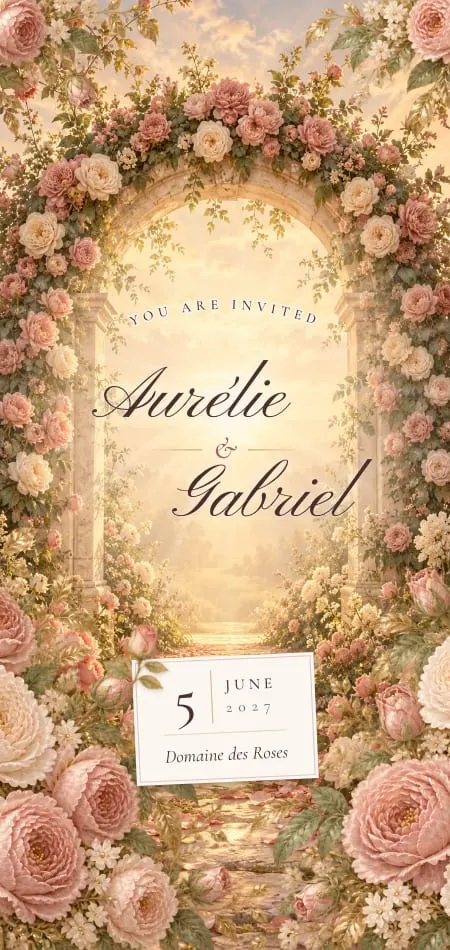
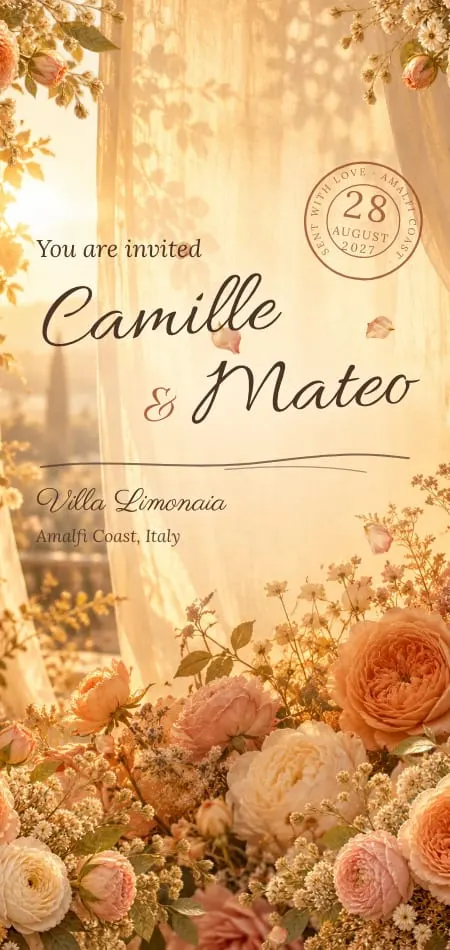
Roseraie is old rose at golden hour: guests touch an old-rose wax seal, petals spill from the envelope, and your names rise beneath an arch of climbing roses (more in romantic wedding invitations). Billet Doux is apricot: a parchment love letter sealed with a dried rosebud, unfolding onto golden-hour light; our demo couple marry on the Amalfi Coast, a destination wedding in Italy.
Garden wedding invitations: let the venue choose
For garden wedding invitations, choose the design by the kind of garden, not by the flower: a rose garden, a glasshouse and a lavender field each ask for a different first moment. Here is each garden we have drawn, matched to its design:
| Your garden | The feeling | The flowers | Design | How it opens |
|---|---|---|---|---|
| A rose garden at golden hour | Romantic, warm | Old roses, sage | Roseraie | A wax seal lifts, petals spill |
| A white garden by candlelight | Enchanting, evening | White roses, jasmine, ivy | Portail | Garden gates swing open |
| A Victorian glasshouse | Fresh, daytime | Citrus in bloom | Orangerie | Guests wipe the fogged glass |
| A botanist's garden party | Tender, collected | Pressed flowers | Herbier | A flower press is unstrapped |
| A lavender field in Provence | Sunny, unhurried | Lavender, sunflowers | Lavande | Blue shutters are thrown open |
| A château garden | Romantic, French | Rose toile | Toile | A painted screen folds back |
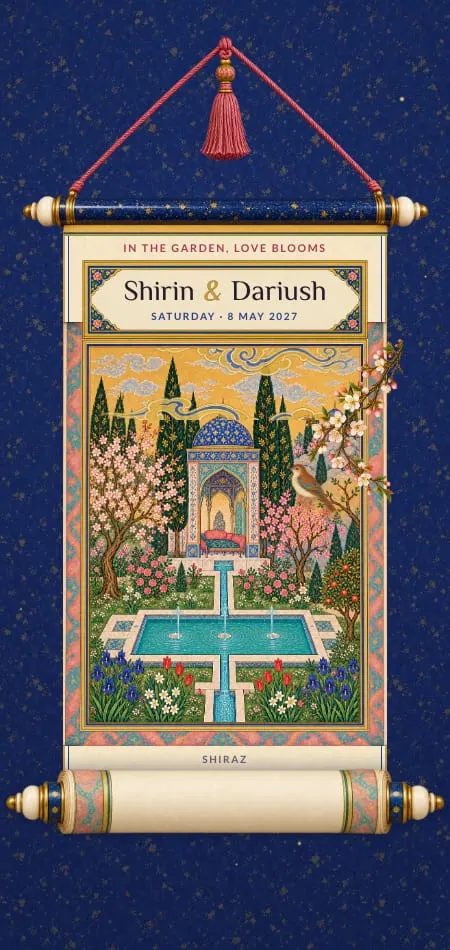
| A Persian garden | Lyrical, jewel-bright | Roses, pomegranates | Golestan | A scroll is unrolled |
| A terrace at golden hour | Tender, warm | Apricot roses | Billet Doux | A love letter unfolds |
| An indoor still life, by candlelight | Sumptuous, autumnal | Peonies, flamed tulips | Clair-Obscur | A peony blooms by a candle |
| A morning wedding with something blue | Fresh, crisp | Forget-me-nots | Ruban | A silk bow is untied |
| A black-tie evening | Glamorous | White orchids, calla lilies | Soirée | A black pochette opens in a spiral |
Secret garden wedding invitations
A secret garden is about the moment of entry. Portail's gates are closed and tied, so every guest opens your garden for themselves. By day, Orangerie has guests wipe the fogged glass of a glasshouse before its iron doors swing open onto the orange trees.
Garden party wedding invitations
Daylight, lawn, a little informality. In Herbier, guests unstrap a flower press and a herbarium sheet rises with a wreath of pressed flowers. Toile is the château version; Lavande ends in a Provençal market where every reply is a bouquet tied with raffia.
Evening and candlelit gardens
After dark, pale flowers carry the scene: Portail's white roses on black iron, a peony opening beside a candle in Clair-Obscur, white orchids and calla lilies under gold foil in Soirée.

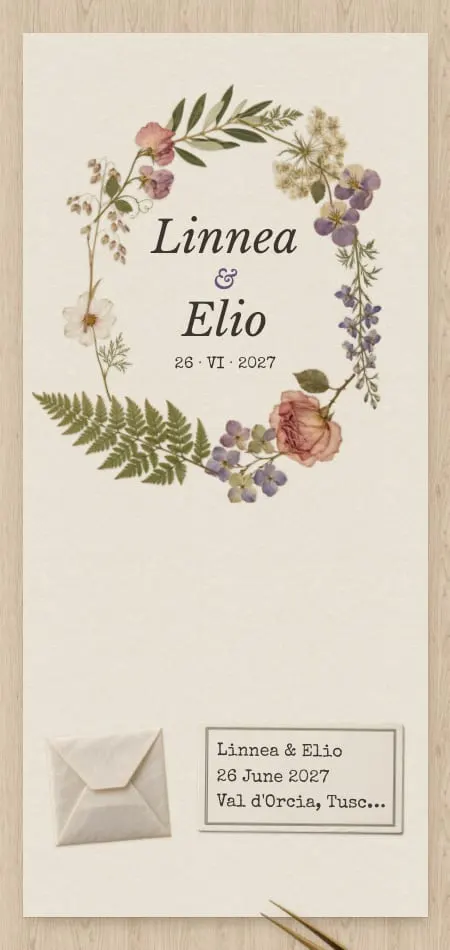
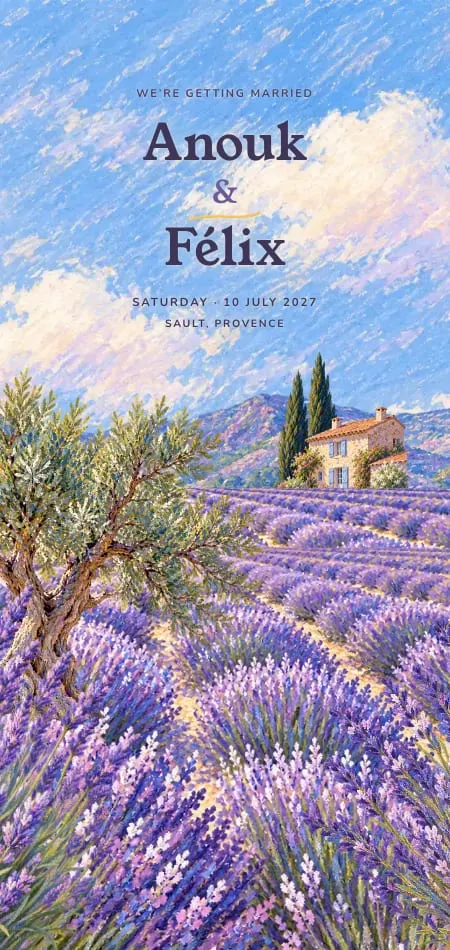
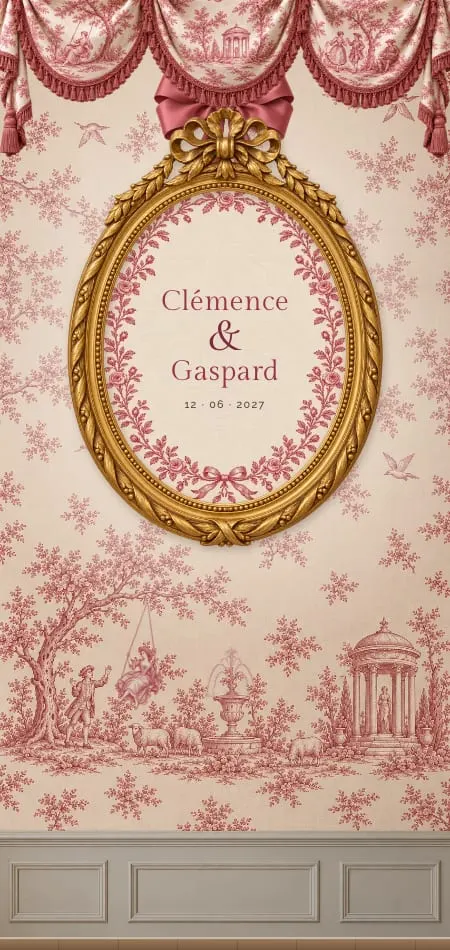
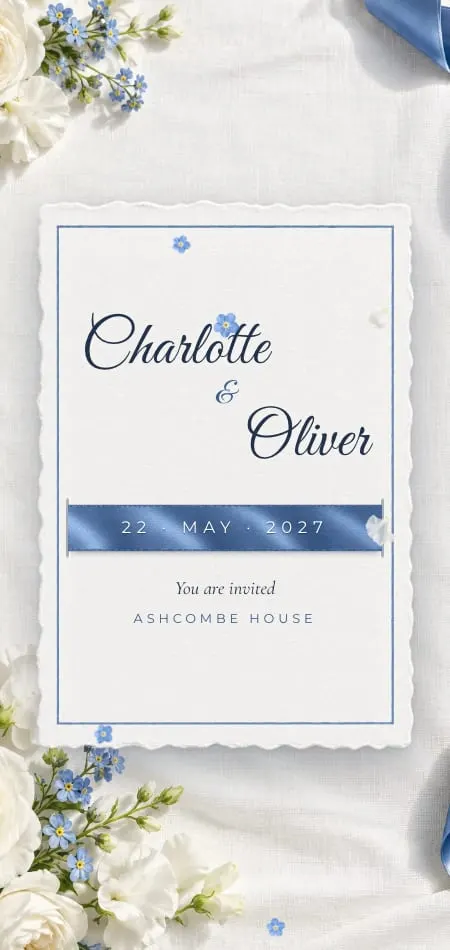
For something blue, Ruban ties a French-blue silk bow around white cotton paper scattered with forget-me-nots; our guide to dusty blue wedding invitations has the rest of the blues. For peonies with lace and pearls, Dentelle is in our guide to lace wedding invitations. For every theme beyond flowers, see our digital wedding invitation ideas.
Match the invitation's flowers to the bouquet and the season
Choose the invitation's hero flower from what will be in season on your date, then tell your florist it is on the invitation. Invitations go out 8–12 weeks before the wedding, often before the last florist meeting, so pick the one flower you are sure of.
| Season (northern hemisphere) | In season | Invitation mood | Designs |
|---|---|---|---|
| Spring (March to May) | Orange blossom, lily of the valley, forget-me-nots, the first peonies | Fresh, light, morning | Orangerie, Ruban, Éventail |
| Early summer (June) | Peonies, roses, jasmine, lavender | Romantic, abundant | Roseraie, Portail, Dentelle |
| High summer (July to August) | Roses, lavender, hydrangeas, myrtle | Golden hour, garden party | Lavande, Herbier, Toile, Golestan |
| Autumn (September to November) | Late roses, hydrangeas fading to antique tones | Candlelit, warm | Clair-Obscur, Billet Doux |
| Winter (December to February) | Ivy, orchids, calla lilies, white roses from growers | Evening, black tie | Soirée, Portail |
In the southern hemisphere, shift every row by six months. Our guide to seasonal wedding invitations sorts the whole collection by month and light, and when to send wedding invitations has the full timeline.
Four ways to tie the invitation to the bouquet:
- Send your florist the invitation. One look at the palette saves a page of notes.
- Repeat one flower, not all of them. If the invitation has white roses and ivy, the bouquet can add whatever is best that week.
- Match the colors, not just the species. Roseraie's old-rose wax can be the bouquet's ribbon; see wedding invitation colors.
- Carry it onto the day: the same flower on the table cards and the menu closes the circle.
How many flowers is too many?
Three kinds of flower on one invitation is the ceiling: one hero flower, one foliage and one optional accent. Beyond that, the flowers stop meaning anything and start competing with your names.
| Too much | Just right |
|---|---|
| Six species in every corner | One hero flower, one green, one accent |
| Flowers behind the date and the address | Flowers framing the text, never under it |
| A different flower in every section | The same flower returning, section after section |
| Petals that never stop falling | Petals that fall once, at the opening, then stillness |
| A floral script for every line | Script for the names; a readable serif for the times |
| Every color of the garden | Two or three colors, taken from the bouquet |
Portail is the model: white roses, jasmine and ivy, and nothing else. The test is the same as for any invitation: take a screenshot of any moment. If you can't find the date in two seconds, there are too many flowers.
Garden wedding invitation wording to copy
A garden invitation needs the usual facts plus three lines a ballroom invitation can skip: what to wear on grass, what to bring for the evening and what happens if it rains. Copy these and change the names. For every host and register, see our guide to wedding invitation wording.
1. Formal, a white garden by candlelight (our Portail demo couple, Eleanor and James):
Together with their families
Eleanor & James
request the pleasure of your company
as they marry in the white garden, by candlelight
Saturday, the seventeenth of July, 2027
at half past seven in the evening
Hartwell Gardens, Sevenoaks, Kent
Dinner in the Glasshouse to follow
2. A garden party:
Clara & Tom are getting married in the garden,
and it would not be the same without you.
Saturday 5 June 2027 at 2 p.m.
Ceremony on the lawn, then tea, cake and dancing under the trees.
3. A rose garden:
Under the climbing roses where we first met,
we are saying yes.
Join us at golden hour, and stay until the roses go blue in the dusk.
4. A secret garden:
Through the gates and into the garden:
come and celebrate our wedding
on Saturday 11 September 2027.
5. A flower key, for your story section:
The flowers on our invitation are the flowers of our day: white roses, for "I am worthy of you"; ivy, for fidelity; and jasmine, because it scented the evening we met.
6. Shoes and the evening:
The paths are gravel and lawn: block heels or flats will thank you.
The garden cools after sunset, so bring a wrap.
7. A rain plan:
If the sky has other plans, the ceremony moves into the Glasshouse, a few steps away. We will update this invitation by noon on the day.
Should it rain, umbrellas will be waiting at the gates.
8. Petals instead of confetti:
Please leave the confetti at home: we will hand out dried rose petals at the gates.
The dress code deserves its own line; "Garden party attire" or "Evening garden attire" are the usual words, and our guide to the wedding dress code explains what each one means.
Paper or digital for a floral invitation?
Paper wins on touch: pressed petals and letterpress roses are things you can hold. Digital wins on movement and on the rain plan, since gates can open, a peony can bloom and the invitation can be updated on the morning of the wedding. Many couples print a few cards for the people who will frame them and send one link to everyone else; see digital vs paper wedding invitations.
At Veiloria, each design is one payment for unlimited guests: $199 Essential, $599 Premium, $999 Bespoke, or the equivalent in your currency. For the most striking openings side by side, see the most beautiful wedding invitations; for white flowers in a quieter register, old money wedding invitations.
Keep reading: romantic wedding invitations · lace wedding invitations · seasonal wedding invitations · cultural wedding invitations
Sources
- Kate Greenaway, Language of Flowers (London: George Routledge and Sons, 1884), Project Gutenberg eBook #31591, checked 28 October 2026. Every Victorian meaning in this post is quoted from it.
- Vanderbilt University Library, Le langage des fleurs, checked 28 October 2026: the first popular book on the language of flowers.
- The Royal Household, Royal wedding traditions, checked 28 October 2026: Queen Victoria's orange blossom wreath (1840) and the royal myrtle.
- English Heritage, The history of Osborne myrtle in royal weddings (26 April 2018), checked 28 October 2026.
- Westminster Abbey, Royal wedding bouquet returned to Abbey (1 May 2011), checked 28 October 2026: the flowers of the 2011 bouquet and their meanings.
- Mary Wilbur, The White Garden, Pacific Horticulture, checked 28 October 2026.
Frequently asked questions
What flower symbolizes marriage?
Ivy and myrtle are the two flowers that stand for marriage in the Victorian language of flowers. Kate Greenaway's 1884 dictionary gives ivy "Fidelity. Marriage." and myrtle "Love.", and Westminster Abbey described the myrtle in the 2011 royal bouquet as "the emblem of marriage". Orange blossom, "Chastity. Bridal festivities.", is the third classic bridal flower.
What do white roses mean on a wedding invitation?
In the language of flowers, a white rose says "I am worthy of you", and the bridal rose means "happy love". On an invitation, white roses read as bridal and stay luminous at night, which is why they suit an evening garden wedding. Portail, our white-garden design, pairs them with jasmine and ivy.
What are the best flowers for a garden wedding invitation?
The best flowers for a garden wedding invitation are the ones growing in your garden on the day. In June that means roses, peonies and jasmine; in high summer, lavender and hydrangeas; in spring, orange blossom and lily of the valley. Choose one hero flower and repeat it in the bouquet.
How do you word a garden wedding invitation?
Word it like any invitation (who is hosting, your names, the date, time and place) and add three garden lines: what shoes to wear on grass, a wrap for the evening and a rain plan. For example: "If the sky has other plans, the ceremony moves into the Glasshouse." A digital invitation can be updated on the morning of the wedding.
Do peonies have a bad meaning?
In Kate Greenaway's 1884 dictionary, the peony means "Shame. Bashfulness.", and the hydrangea and lavender fare no better. Today peonies are chosen for romance and abundance, and almost no guest will read them otherwise. If you care about the Victorian code, pair them with ivy or myrtle, or explain your choice in a short flower key.