
Wording13 min read
Our Love Story Examples: How to Write Yours (12 to Copy)
How to write the "our story" section of your wedding invitation or website: structure, length, voice, tone, what to leave out, and 12 love story examples.
By The Veiloria AtelierPublished Updated
Contents
- What is the "our story" section?
- The structure that works: four beats
- How long should your love story be?
- 5 questions to answer before you write
- Who writes it: "we", or the third person?
- Tender, funny, poetic or formal: choose a tone
- What to leave out
- How to tell the proposal story
- A timeline instead of paragraphs
- Writing your love story in two languages
- 12 love story examples to copy
- How your story appears inside a designed invitation
- The two-line version for your Save the Date
- Frequently asked questions
To write your love story for a wedding website or invitation, tell it in four beats: how you met, the moment it turned, the proposal, and why this day and this place. Keep it to 80–150 words (two lines for a Save the Date), write it together in "we", and leave out anything your grandmother shouldn't read.
Below: structure, length, voice, tone, what to leave out, the proposal, a timeline, two languages, 12 examples to copy, and how a designed invitation frames your story.
What is the "our story" section?
"Our story" is the short section of a wedding invitation or website where the two of you tell guests how you met and how you got here. It is optional (our guide to what to include in a wedding invitation lists what is not), but it is the section guests read twice. Your friends know how you met, your in-laws know the proposal, your grandmother may know neither: the story gives everyone the same chapters before the day.
On a wedding website it often has a page of its own; in a digital invitation it is one section between the cover and the programme. Our comparison of a wedding website vs an invitation sets out what belongs where.
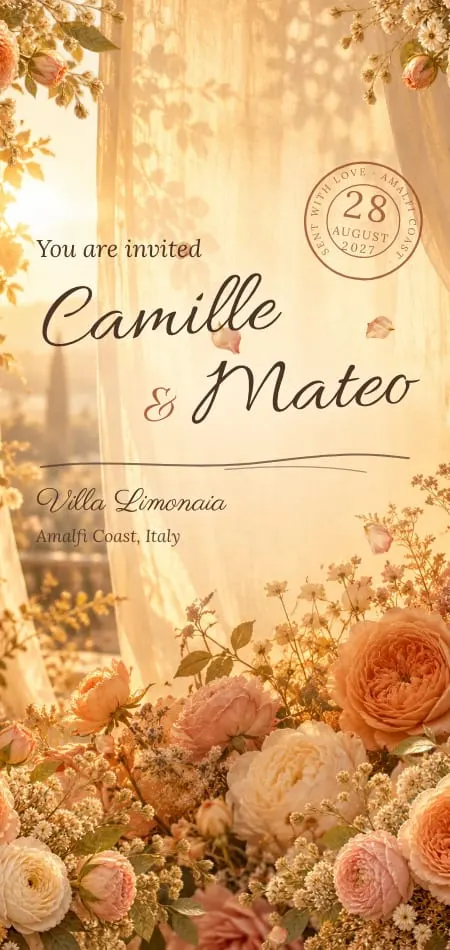
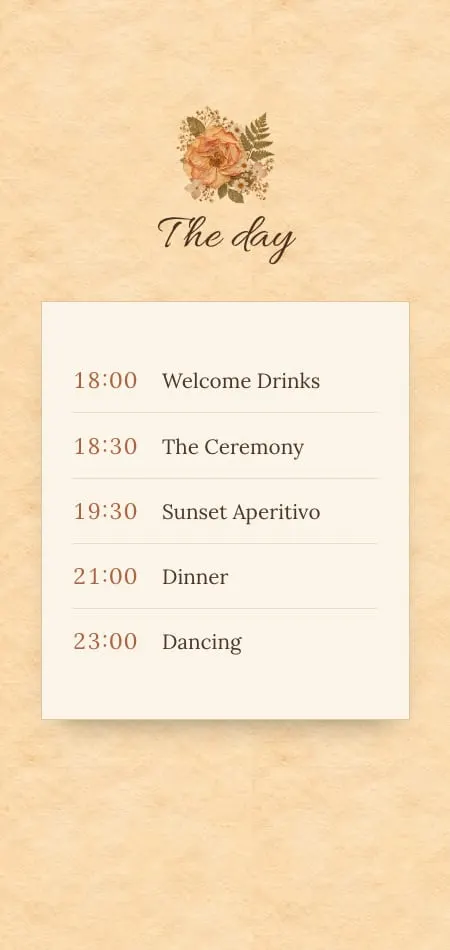
In Billet Doux, the whole invitation is a love letter sealed in apricot wax, and its "Our story" section is the letter itself, set in a handwritten script.
The structure that works: four beats
A wedding love story needs four beats, in order: how you met, the turn, the proposal and why this day. Each beat is one or two sentences. Skip a beat if it has nothing to say; never add a fifth.
| Beat | The question it answers | Example line | Words |
|---|---|---|---|
| 1. How we met | Where, when, and the one detail that makes it yours | "We met in the queue for the last train out of Lyon, both holding the wrong ticket." | 20–40 |
| 2. The turn | When a meeting became the two of you | "Somewhere between Dijon and Paris, we stopped being strangers." | 15–30 |
| 3. The proposal | Who asked, where, and one sensory detail | "Six years later, Luis asked on the same platform, in the rain, with a ring and a croissant." | 20–40 |
| 4. Why this day | Why this date, this place, these people | "We are marrying in Burgundy, halfway between our two families, and we want you there." | 20–40 |
The fourth beat is the one couples forget and guests need most: it turns a memory into an invitation.
How long should your love story be?
For an invitation or a wedding website section, 80 to 150 words; for a Save the Date or a cover, one or two lines. That is about the attention a guest gives one section on a phone.
| Where it appears | Length | What to keep |
|---|---|---|
| Save the Date or invitation cover | 1–2 lines (10–25 words) | One image: where you met, or the proposal |
| "Our story" section of a digital invitation | 80–150 words | The four beats, one or two sentences each |
| Wedding website story page | 150–300 words, or a timeline | The four beats plus two or three milestones |
| Notes for your officiant | As long as you like | Everything you'd like said aloud, shared privately |
5 questions to answer before you write
Answer these five questions separately, then compare notes. Where your answers overlap is your story.
| Question | Why it matters | A one-line answer |
|---|---|---|
| 1. Where and when did we meet? | Beat one: the scene | "In a friend's kitchen, at a birthday, in March 2019" |
| 2. When did we know? | Beat two: the turn | "The night the power went out and we talked until 4 a.m." |
| 3. How did the proposal happen? | Beat three, or a decision made together | "On a hike, at the top, out of breath" |
| 4. Why this place and this date? | Beat four: the invitation | "It's where his grandparents married" |
| 5. What do we want guests to feel? | The tone | "That they were part of it all along" |
Who writes it: "we", or the third person?
Write it in "we", together, unless the invitation is formal or hosted by your parents. "We met at university" is warm and sounds like you. The third person ("Ana and Luis met at university") reads more formally and fits invitations that already speak about you ("together with their families, Ana and Luis request…").
- Keep one voice to the end. Don't start with "we" and finish with "Luis and I".
- Read it aloud to each other. Anything one of you wouldn't say comes out.
- Show it to whoever is hosting, especially parents. It saves a conversation later.
Tender, funny, poetic or formal: choose a tone
Holding one tone from first line to last matters more than which tone you choose. Here is the same meeting in four tones:
| Tone | The same moment |
|---|---|
| Tender | "We met in a bookshop on a rainy Tuesday, both reaching for the same worn copy. Neither of us let go." |
| Funny | "We met reaching for the same book. Luis insists he saw it first. He did not." |
| Poetic | "One rainy Tuesday, one book, two hands. We have been writing the rest ever since." |
| Formal | "Ana and Luis met in a bookshop in Seville on a rainy afternoon in 2018." |
Match the tone to the invitation: a funny story under a black-tie dress code jars. To close with a line of poetry, our love quotes for wedding invitations has public-domain verses that sit well under a story.
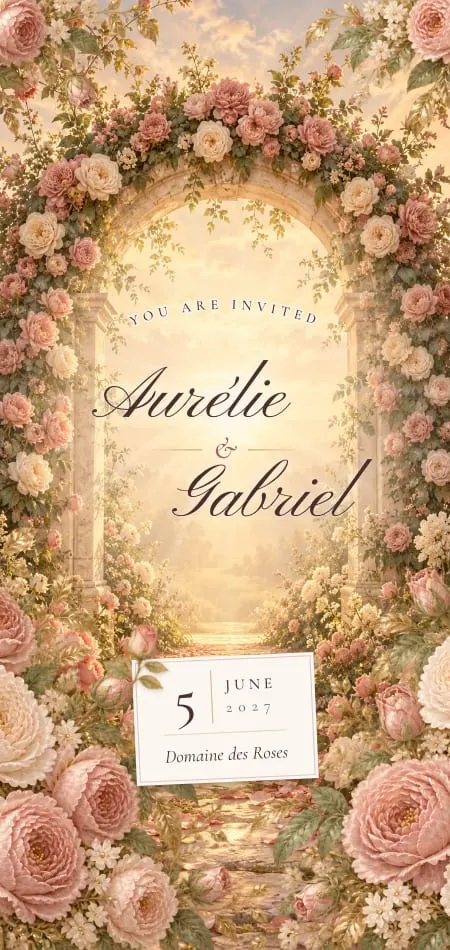
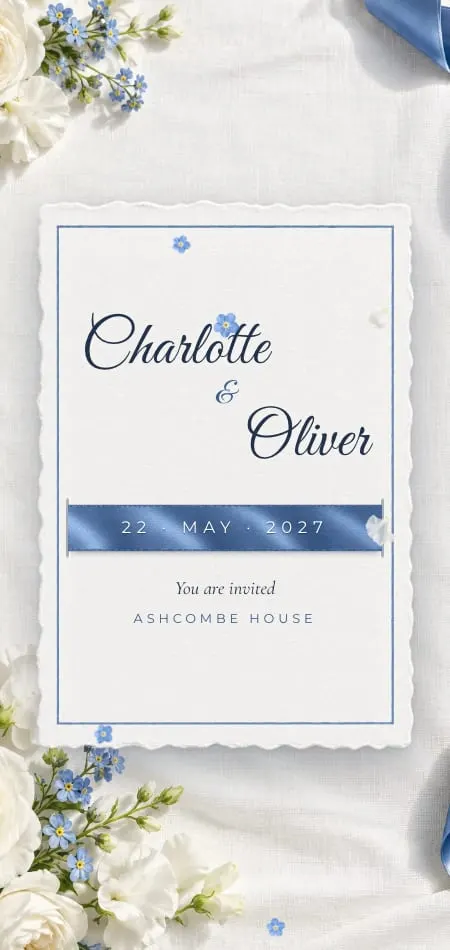
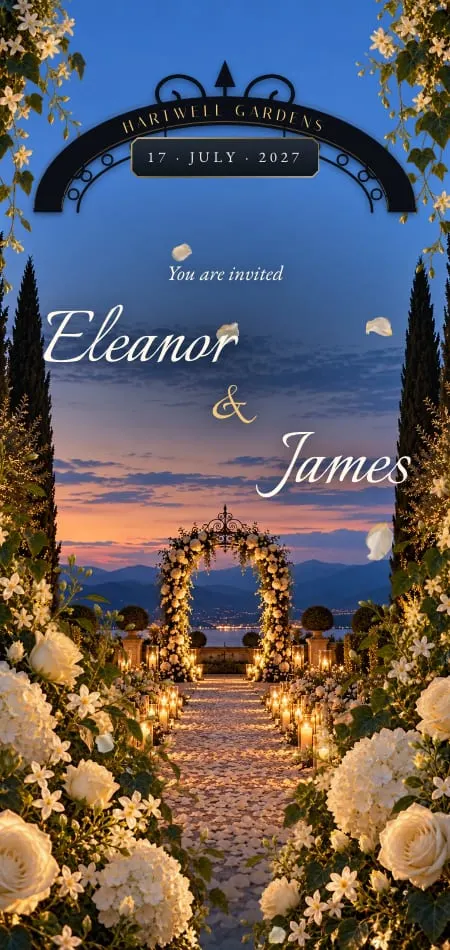
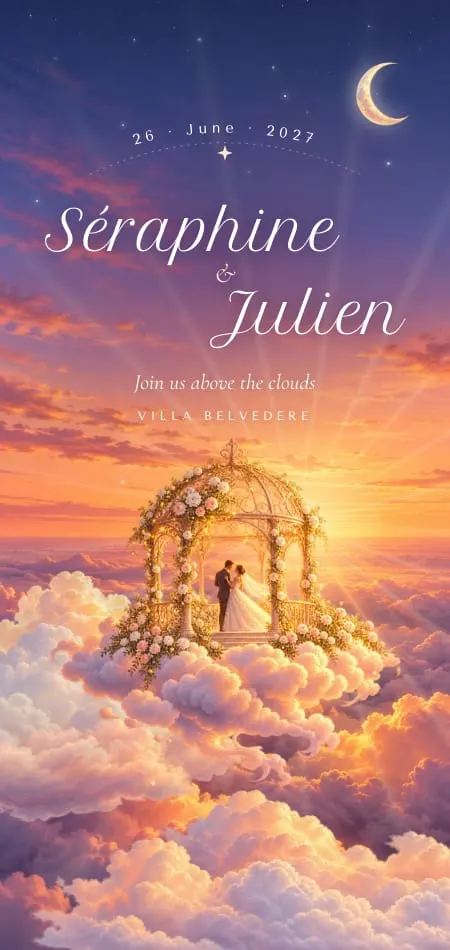
A tender story deserves a design that says the same thing first: a rose garden at golden hour, a silk bow to untie, garden gates onto a candlelit aisle, a rise through the clouds. Our guide to romantic wedding invitations shows all seven romance designs.
What to leave out
Leave out anything that needs explaining, anything that embarrasses someone, and anything a grandparent shouldn't read. Your boss, your grandmother and your oldest friend will read it on the same evening.
- Exes, including "after a hard year". Some guests know the names.
- Inside jokes nobody gets. If the punchline needs the backstory, cut it.
- Too much detail: one detail per beat, not the name of every bar.
- Anything a grandparent shouldn't read.
- Money, and other people's private moments (a friend's divorce, a family illness) unless they have said yes.
- Disputes about the facts. If you still argue about who texted first, make it the joke or leave it out.
How to tell the proposal story
Tell the proposal in two or three sentences: where, who asked, and one detail. Guests don't need the plan, only the moment:
Five years after that first dinner, on a cold beach in Brittany, Luis knelt in the sand, and a wave reached his trousers before Ana could answer. She said yes anyway.
If there was no proposal, say so: "We decided over breakfast, on an ordinary Sunday" is as true as any knee in the sand. If you both asked, that is a story too: "We each had a ring in a pocket. Neither of us knew."
A timeline instead of paragraphs
A timeline suits a wedding website, a long relationship or couples who would rather list than write. Keep it to five or six dates, one line each:
2016 · We meet in a philosophy seminar. Ana disagrees with everything Luis says.
2020 · The same city at last, and a very small flat in Madrid.
2023 · Olivia the dog joins the family.
2026 · Luis proposes at the top of Montjuïc.
2027 · We get married. You're invited.
The last line is the point: the timeline ends with the guest in it.
Writing your love story in two languages
Write the story once in each language, rather than once and translated. Idioms rarely survive word-for-word translation, and humour is the first casualty. Ask a native speaker from each family to retell it, keeping the names and the four beats. In Arabic, a story told about the couple uses the dual (التقيا, "the two of them met"), which machine translation often misses. Our bilingual wedding invitation wording guide has wordings side by side for seven language pairs.
12 love story examples to copy
Our atelier wrote these 12 examples for this guide; the names are placeholders, not real couples. Swap in your names, places and details, and trim to your length.
1. Met at university
We met in the second week of university, in a seminar neither of us wanted to take. Luis sat beside Ana because it was the only free chair. We argued for a term, studied together for three years, then stopped pretending we were only studying. Now we are marrying a few streets from that classroom, and we would love you to walk them with us.
2. Met on a dating app
We matched on a Tuesday, and Maya's first message was a question about Sam's dog. Our first coffee turned into dinner, then a walk to a bus Sam missed on purpose. We met the way so many couples meet now, and we're proud of it. Four years later, we're saying yes in the garden of our third date.
3. Childhood friends
Our mothers say we met at three, in a sandpit, over a red bucket. We grew up two houses apart and wrote to each other more than we admitted. One summer home, Clara looked across the same street at Tomás and saw someone new. Twenty-five years after the bucket, we are marrying in the village where it started, among everyone who watched us grow up.
4. Set up by friends
Our friend Lucía had been telling each of us about the other for a year. We finally met at her birthday dinner, where she sat us side by side and spent the evening pretending not to watch. By dessert, we were planning a trip. Lucía has been unbearable about it ever since, and she has earned it.
5. Colleagues
We met on the first day of a project meant to last three weeks. It lasted two years; we lasted longer. Elena noticed that Marc always brought two coffees to the morning meeting, and Marc noticed she never asked who the second one was for. At the office party, everyone claimed they had known for months. Now we would like you all to know it properly, on 12 June.
6. Long distance
For our first two years, there were 5,000 kilometres between us: Priya in Toronto, Daniel in Edinburgh. We had a calendar of time zones, a shared playlist and more airport goodbyes than we could count. Last spring, we finally moved into one home. Now we would like to stop counting kilometres and start counting years, with you there for the first one.
7. Met while travelling
We met on a night ferry to Naxos, both sleeping on deck because the cabins were full. Sofia lent Nico her jacket, Nico lent Sofia his headphones, and by sunrise neither of us had slept. We changed our plans, then our flights, then our cities. Now we are going back to the Aegean to get married, and this time we have booked cabins for everyone.
8. Second chance love
We first met at twenty and weren't ready: different cities, different plans, the wrong moment. Twelve years later, a friend's wedding put us at the same table, and we talked as if no time had passed. This time we are ready, grateful for the years that made us who we are, and happy to begin the next ones with all of you around us.
9. Second marriage and a blended family
We met at the school gate, two parents running late on a Monday morning. Our children became friends before we did, and they will tell you they planned the rest. Today our family has four children, two dogs and one very long kitchen table. On 4 September we make it official, with the children walking us down the aisle.
10. Introduced by our families
Our families have been friends for thirty years, and our parents introduced us at a summer lunch, hoping we would get along. We did, slowly and then all at once. We met many times with our families around us before we met alone. With the blessing of both families, we will marry in Jaipur in December, and we would be honoured to celebrate with you.
11. The dog (or the neighbour)
Our story begins with Biscuit, Hugo's dog, who escaped one Sunday into Lea's garden next door. Lea brought him back. Biscuit escaped again the next Sunday, and the next, and by the fourth Hugo had stopped mending the fence. Today we share one garden, a fence that is still broken and a very pleased dog. He will be carrying the rings.
12. A short, poetic version
One street, two windows, a thousand evenings.
Neighbours, then friends, then home to each other.
On 18 September 2027, by the sea, we will say the rest out loud.
How your story appears inside a designed invitation
In a designed digital invitation, your story is not a paragraph in a box: each design gives it a form of its own.
- Billet Doux: a letter on parchment, dated from your venue, opening "Dearest friends and family," and signed "With all our love, yours," above your names, beside a pressed flower and the broken seal. Our demo couple, Camille and Mateo, recall the weekly letters of their first year apart.
- Chapitre: a green morocco book whose title page sets itself line by line, "the story of you two".
- Écrin: a ring box that becomes a music box, where your story lies in a locket.
- Carré: a silk carré composed for the two of you, where your story is the designer's maquette.

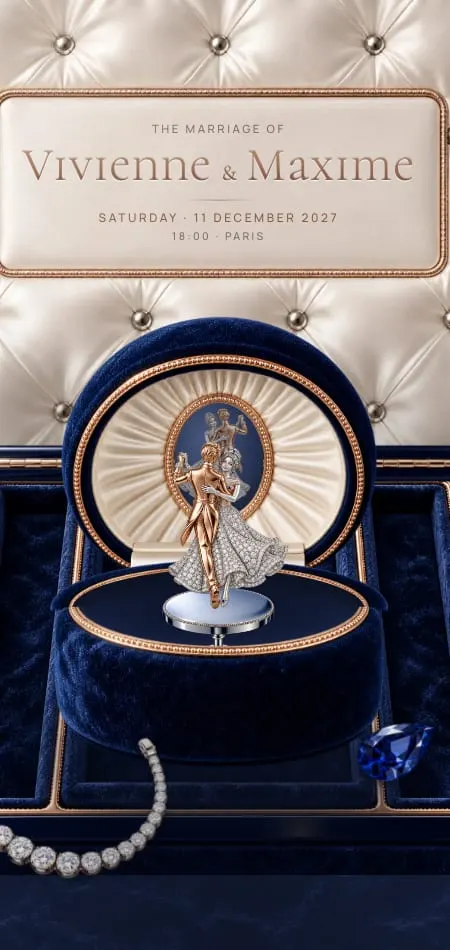
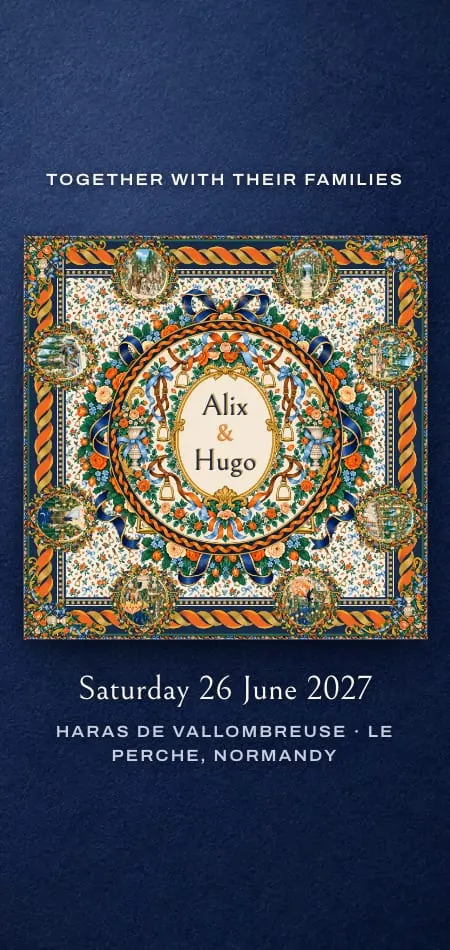
The form changes what to write: a letter invites the tender version, a book can carry a timeline, a locket asks for the short, poetic one. To set a photograph beside the story, see our guide to wedding invitations with photos.
You don't have to write it alone. At Veiloria, your designer writes every section around your wedding, in your order and your languages. Send us the raw material (your five answers, a draft, a few memories) and we shape it to the design. You read it in a private proof, nothing is shared until you approve it, and you have 2 rounds of revisions on Essential, 4 on Premium and 7 on Bespoke.
The two-line version for your Save the Date
A Save the Date carries your names, the date, the place and, at most, one line of story. Take one image from your four beats and stop there:
Ten years after a seminar neither of us wanted to take,
Ana & Luis are getting married.
Saturday 12 June 2027 · Seville
Invitation to follow
Billet Doux's Save the Date plays the same opening as the invitation. Our save the date wording guide has 40 more lines, the digital save the date guide covers timing, and wedding invitation wording covers every other section around your story.
Frequently asked questions
What do you write in "our story" on a wedding website?
Write how you met, the moment it turned into love, the proposal and why you chose this day and place, in one or two sentences each. End with a line that brings guests in, such as "and we want you there".
How long should our love story be for a wedding website?
Aim for 80–150 words for a website section or an invitation, and one or two lines for a Save the Date. A story page of its own can run to about 300 words or become a timeline. Shorter is almost always better: most guests read on a phone.
Should our wedding love story be in the first or third person?
The first person plural ("we") is the most natural choice and sounds like the two of you. The third person ("Ana and Luis met…") suits formal invitations, especially when parents are hosting. Whichever you choose, keep one voice to the end.
Is it OK to say you met on a dating app?
Yes, and say it proudly: many couples meet online now. Name the app or don't, then spend your words on the first date, which is the better story.
What should you not include in a wedding love story?
Leave out exes, inside jokes, money, anything intimate and other people's private moments. A good test: would you be comfortable hearing your grandmother read it aloud? If not, cut it.