
Comparisons9 min read
Digital vs Paper Wedding Invitations: 12 Differences
Paper or digital? Twelve differences side by side, from postage and reply cards to guests abroad and keepsakes, plus the hybrid most couples end up choosing.
By The Veiloria AtelierPublished Updated
Contents
- Digital vs paper wedding invitations: the short answer
- 12 differences between digital and paper invitations
- When paper invitations still win
- When digital invitations win
- Hybrid wedding invitations: digital for everyone, paper for a few
- Is digital more sustainable? What we can and can't say
- Sources
- Frequently asked questions
Digital vs paper wedding invitations split cleanly: digital wins on speed, replies and changes, arriving in seconds and staying correctable after sending, while paper wins as a keepsake and for guests who don't live on their phones. For most couples, the best answer is a hybrid: digital for everyone, paper for a few.
Below: the 12 differences, where each format wins and how to run a hybrid. We make Veiloria's digital invitations, so read this knowing our bias; every outside number is linked and dated (checked 19 October 2026).
Digital vs paper wedding invitations: the short answer
Choose digital if speed, replies and the freedom to change details matter most; choose paper if the invitation itself is the object you want to keep. A digital wedding invitation, also called an online invitation or e-invite, is one guests open on their phone or computer from a link, with the day's details and the RSVP inside. A paper invitation is a printed card, usually with inserts and a reply card, sent by mail.
Both are accepted now; are digital wedding invitations tacky? covers the etiquette. Once you've chosen digital, our fair comparison of the best digital wedding invitation sites is the next read.
12 differences between digital and paper invitations
| Paper | Digital | Hybrid | Edge | |
|---|---|---|---|---|
| 1. Cost | Printing plus postage per household | Free to about $1,000; one-price or per guest | Digital price plus a few cards and stamps | Digital |
| 2. Time to produce | 3–4 weeks of printing, plus addressing | Minutes (self-made) to 1–2 weeks (designed) | Digital timing | Digital |
| 3. Delivery | Days by mail; no proof it arrived | Seconds, by WhatsApp, text or email | Both | Digital |
| 4. RSVP | Reply cards mailed back, tallied by hand | Replies collected in one list as they arrive | One list; paper replies added by hand | Digital |
| 5. Changes after sending | Reprint, or mail a correction card | Update the same link | Card holds only essentials | Digital |
| 6. Guests abroad | $1.75+ per letter from the US, slower | Same link, anywhere | Digital abroad, paper at home | Digital |
| 7. Languages | Crowded bilingual card or two print runs | Each guest can read their own | Both | Digital |
| 8. Accessibility | No device needed | Zoomable text, one-tap maps | Covers both kinds of guest | Hybrid |
| 9. Keepsake | Something to hold, frame and keep | A link and screenshots | Paper for those who'll keep it | Paper |
| 10. Sustainability | Paper, ink, transport, mail | Devices and servers | Fewer printed pieces | No reliable figure |
| 11. Formality | The traditional register | As formal as its design and wording | Paper where formality is expected | Paper, narrowly |
| 12. Effort for you | Addressing, assembly, stamps, post office | Collecting numbers and sending | A short run of envelopes | Digital |
1. Cost
Paper costs more, and the cost grows with every household you invite. US couples spent an average of $220 on printed invitations with reply cards and $510 on their full stationery suite (The Knot 2026 Real Weddings Study, 10,474 couples married in 2025). Zola's cost guide (updated February 2026) puts a standard suite for a 100-guest wedding at $400–$600, basic postage included.
Postage comes on top. For 100 US households, at USPS retail prices effective 4 October 2026:
| Line | Paper | Digital |
|---|---|---|
| A 2-ounce square invitation | $1.11 + $0.49 nonmachinable surcharge = $1.60 each | $0 |
| 100 invitations mailed | $160 | $0 |
| Stamped reply envelopes | 100 × $0.82 = $82 (or $65 as reply postcards) | $0 |
| Postage before printing | $242 | $0 |
Digital invitations range from free to about $1,000, charged per guest or once for the whole list; see Paperless Post vs Greenvelope for how per-guest pricing adds up. Totals by service are in our digital wedding invitation cost guide. Our wedding invitation cost per guest guide works through guest counts.
2. Time to produce
Paper needs months of runway; digital needs days. Zola advises ordering printed invitations 3–4 months before the wedding; most printers need 3–4 weeks for production, before you address and stamp. A self-made digital invitation can go out the same day; ours, designed by hand, takes 7–14 days to the first proof on Essential and Premium, or 1–4 days with Express; Bespoke follows a schedule agreed before work starts.
3. Delivery
A digital invitation arrives in seconds; a letter takes days and leaves no trace. Paper needs a postal address for every household, and a lost envelope goes unnoticed until someone mentions it. Digital needs a phone number or email. What paper has, and digital can only echo, is the envelope on the doormat.
4. RSVP
Digital replies collect themselves; paper replies need a stamp, a mailbox and your tally sheet. Reply cards come back late, unsigned or marked "+ family". With a digital RSVP, each guest accepts or declines, names their party and adds dietary needs, and your list updates as replies arrive.
5. Changes after sending
Printed details are fixed; digital details can be corrected on the same link. A new ceremony time on paper means a correction card and more postage. Online, every guest sees the change next time they open it. At Veiloria, times, addresses and wording are updated free until the wedding.
6. Guests abroad
Digital reaches a guest abroad as fast as one next door. A 1-ounce international letter from the US costs $1.75 (USPS, effective 4 October 2026), a heavier suite more, and it travels slowly. A link reaches the cousin in Melbourne the moment you send it; Veiloria's story begins with exactly that guest list.
7. Languages
Paper must fit every language on one card; digital can give each guest theirs. A bilingual printed card halves the space for each language or doubles the print run. In a Veiloria invitation, each guest reads their own language automatically: two on Essential, up to three on Premium, as many as you need on Bespoke.
8. Accessibility
Paper needs no device, which still matters for some guests. About 91% of US adults own a smartphone, but among adults 65 and older the figure is 79% (Pew Research Center, 2026 survey). Digital helps in other ways: text can be enlarged and the map opens in one tap. More in digital wedding invitations for older guests.
9. Keepsake
Paper is the clear winner as a keepsake. A card can be framed or kept in a drawer for decades. A digital invitation lives as long as its link: ask how long yours stays online (ours stay up at least 12 months after the wedding), and screenshot the cover for your album.
10. Sustainability
Digital avoids paper, ink and mail, but no reliable figure says how much that saves per wedding. More in the section below.
11. Formality
Paper is the traditional register; digital matches it when the design and wording do. A black-tie or religious wedding with older relatives may still expect a card.
12. Effort for you
Paper asks for hours of handwork; digital asks for an evening of messages. Paper means collecting addresses, assembling, addressing, stamping and the post office. Digital means collecting numbers or emails, sending one link and chasing late replies.
When paper invitations still win
Paper wins when the invitation is meant to be held and kept. Choose it, or at least a few printed cards, if:
- You want an heirloom for yourselves or your parents.
- Some guests don't use a smartphone or email comfortably.
- Your families or community expect a printed card for a formal or religious wedding.
- The ritual matters to you: the weight of the envelope, a wax seal, letterpress under the thumb.
When digital invitations win
Digital wins on everything that happens after the invitation is sent. It is the better choice if:
- Guests live abroad or in several countries.
- You need replies, meal choices and head counts in one list.
- Details may still change: a venue, a time, a shuttle.
- Guests read different languages.
- You're sending in under three months, or your list is long.
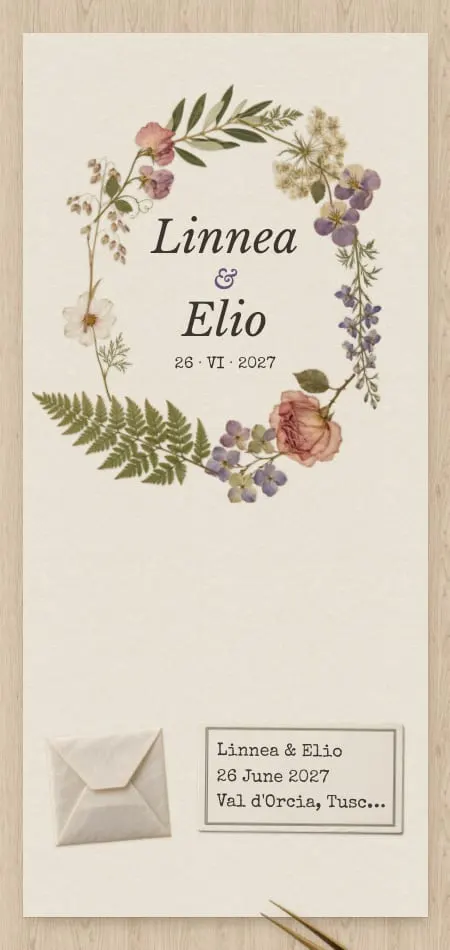
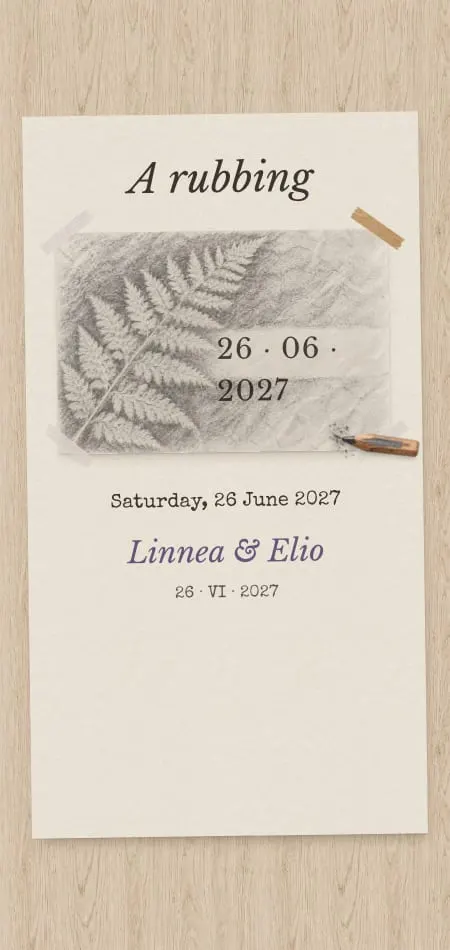
Digital can still feel like stationery. Herbier opens as a flower press: guests slip off two leather straps and a sheet of pressed flowers rises, its label typing your names. See the Herbier digital wedding invitation or open the demo below. Every design is in our collection of 43 wedding invitation designs.
Hybrid wedding invitations: digital for everyone, paper for a few
A hybrid wedding invitation means one digital invitation for every guest and a short run of printed cards for the people who will treasure or need them.
How to run one:
- Send the digital invitation to everyone, so all replies land in one list.
- Choose your paper list: grandparents, guests without a smartphone, your parents, and one card each for yourselves.
- Print a single card, no inserts. Names, date, place and a QR code; the details stay online. Our guide to wedding invitation QR codes covers print size and placement.
- Give non-digital guests a way to reply by phone, and add their answers to the list yourself.
- Mail the cards the same week as the digital send, so nobody hears about the wedding second-hand.
A card you can copy, shown for our demo couple:
Linnea & Elio
request the pleasure of your company
Saturday, the twenty-sixth of June, 2027
Val d'Orcia, Tuscany
Every detail and your reply: scan the code, or call Linnea on (555) 014-2290 by the first of May.
Twelve standard 1-ounce cards cost $9.84 in US postage. Ask your invitation service for a printable QR code; ours comes with every plan.
Is digital more sustainable? What we can and can't say
We don't publish an eco percentage, because we found no lifecycle study that compares paper and digital invitations for a single wedding. Claims like "digital saves X trees" are guesses unless they name one.
What is certain: a paper suite uses paper, ink, envelopes, transport and, with reply cards, two trips through the mail. A digital invitation uses devices guests already own, networks and servers: less material, but not zero.
If you print, the clear reductions are one card instead of a suite, replies collected online instead of by reply card, recycled or FSC-certified paper, and cards only for the guests who want them.
Sources
- The Knot, average cost of wedding invitations (2026 Real Weddings Study, 10,474 US couples married in 2025), updated 30 April 2026.
- Zola, how much do wedding invitations cost, updated 19 February 2026.
- United States Postal Service, Price List, Notice 123, effective 4 October 2026.
- Pew Research Center, Mobile Fact Sheet, 2026 survey of US adults, checked 19 October 2026.
Frequently asked questions
Are digital wedding invitations cheaper than paper?
Usually, yes. US couples spent an average of $220 on printed invitations and $510 on the full suite in The Knot's 2026 study, before postage of $0.82 to $1.60 per US envelope. Digital invitations run from free to about $1,000, and one-price services cost the same for any guest count.
Is it better to send paper or digital wedding invitations?
Digital is better for speed, replies, changes and guests abroad; paper is better as a keepsake and for guests without smartphones. Choose by your guest list, not by etiquette: both are accepted.
Can you do both paper and digital wedding invitations?
Yes, and it's often the best of both. Send one digital invitation to every guest so replies stay in one list, then print a single card with a QR code for grandparents, parents and anyone who prefers paper.
Are digital invitations better for the environment?
They use fewer materials, but no published lifecycle study measures the difference for a single wedding, so be wary of exact percentages. If you print, one card without inserts on recycled paper is the simplest reduction.
Which is better, paper or digital save the dates?
Digital save the dates are usually better, because plans can still shift 6–12 months out and a link can be updated. Printed ones averaged $150 in The Knot's 2026 study. Our digital save the dates match each design's invitation.