Inspiration11 min read
Cultural Wedding Invitations: 12 Traditions in Design
Twelve wedding traditions, from a Marrakech riad to a Swedish midsummer, translated into invitation design, and how to honor two cultures in one invitation.
By The Veiloria AtelierPublished Updated
Contents
- How to honor a tradition without borrowing it carelessly
- Cultural wedding invitation designs at a glance
- Moroccan wedding invitation: a riad door (Zellige)
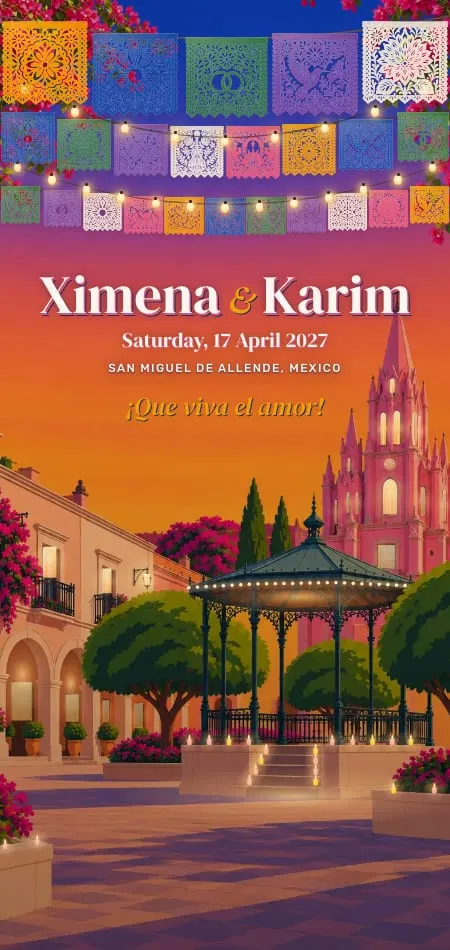
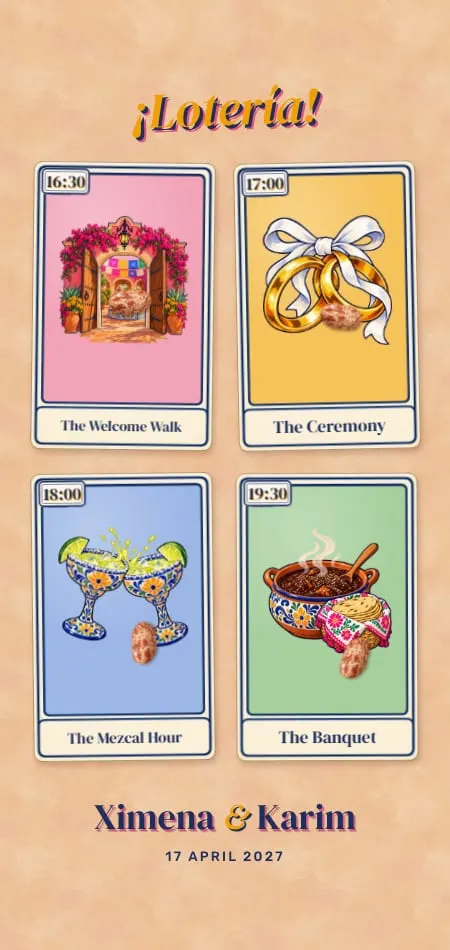
- Mexican wedding invitations: papel picado (Hacienda)
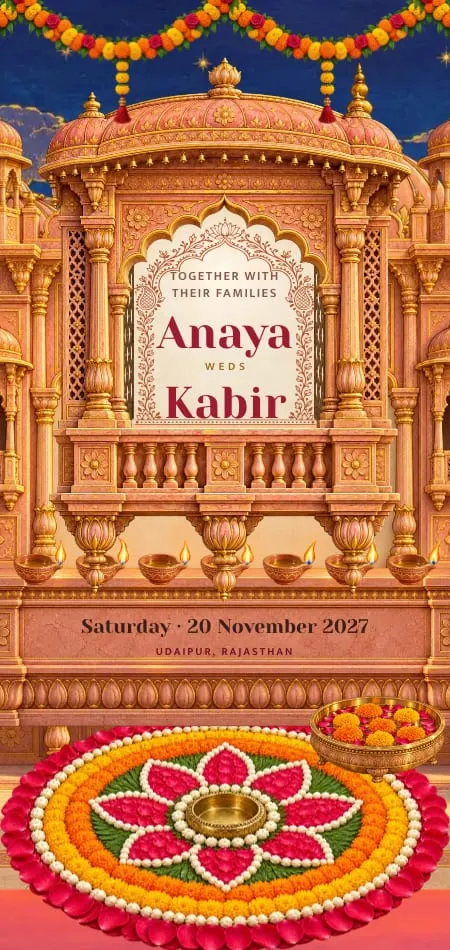
- Indian wedding invitations: jaali shutters and mehndi (Jharokha)
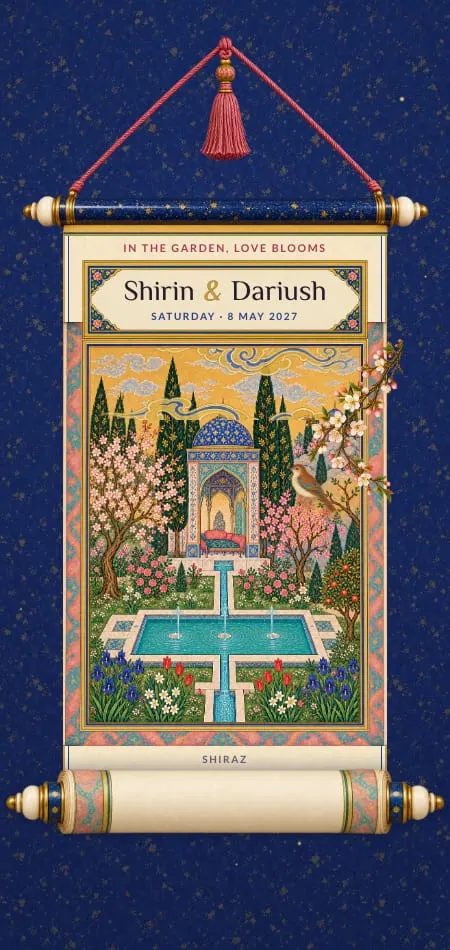
- Persian wedding invitation: the rose garden scroll (Golestan)
- Japanese wedding invitation: kintsugi and the tea room (Kintsugi)
- Spanish wedding invitation: the Andalusian painted fan (Éventail)
- Venetian wedding invitation: Carnival and Murano glass (Serenissima)
- Swedish wedding invitation: midsummer and the maypole (Solstice)
- Costa Rican wedding invitation: the cloud forest (Selva)
- Desert wedding invitation: where the dunes end (Dune)
- French wedding invitations: Champagne, Provence and silk (Bulles, Lavande, Carré)
- Blue-and-white porcelain wedding invitation (Porcelaine)
- Multicultural wedding invitations: two cultures, one invitation
- Sources
- Frequently asked questions
Cultural wedding invitations carry a family's tradition into the invitation itself: its symbols, colors, languages and the order of its celebrations. The best take those details from the families rather than from a stereotype, and on a digital invitation the tradition can shape the opening guests touch, every section and the reply.
Below: the 12 traditions, what each one's invitation needs to say, and how to join two cultures. For what makes any invitation refined, see luxury digital wedding invitations.
How to honor a tradition without borrowing it carelessly
Let the people who belong to a tradition choose what appears, and use each symbol where it belongs.
- Start with family, not a mood board. Ask parents or grandparents which symbols, colors and blessings they expect to see.
- Know what a symbol means. An invocation, a verse or a deity's image carries weight; it usually comes first.
- Mind colors. Red is the wedding color in Chinese and many Indian traditions; white is linked with mourning in some of them.
- Use real words in the right script. Arabic and Farsi letters join right to left; have a reader check them.
- Say "inspired by" when that's what it is. A design drawn from a landscape is not a ceremony.
- Have someone from the tradition read the final proof.
For blessings and verses, see religious wedding invitation wording.
Cultural wedding invitation designs at a glance
Twelve traditions, fourteen designs, each with a live demo set at a real place for one of our multilingual demo couples. Browse them all in the wedding invitation designs.
| Tradition | Design | Drawn from | The opening | Demo couple, place | Languages |
|---|---|---|---|---|---|
| Moroccan | Zellige | A riad, brass lanterns, mint tea | Knock twice | Yasmine & Idris, Marrakech | EN · FR · AR |
| Mexican | Hacienda | Papel picado, Talavera, lotería | Tap | Ximena & Karim, San Miguel de Allende | ES · EN · AR |
| Rajasthani | Jharokha | Jaali shutters, marigolds, mehndi | Swipe | Anaya & Kabir, Udaipur | EN · FR · AR |
| Persian | Golestan | A miniature rose garden | Unroll | Shirin & Dariush, Shiraz | EN · AR · FR |
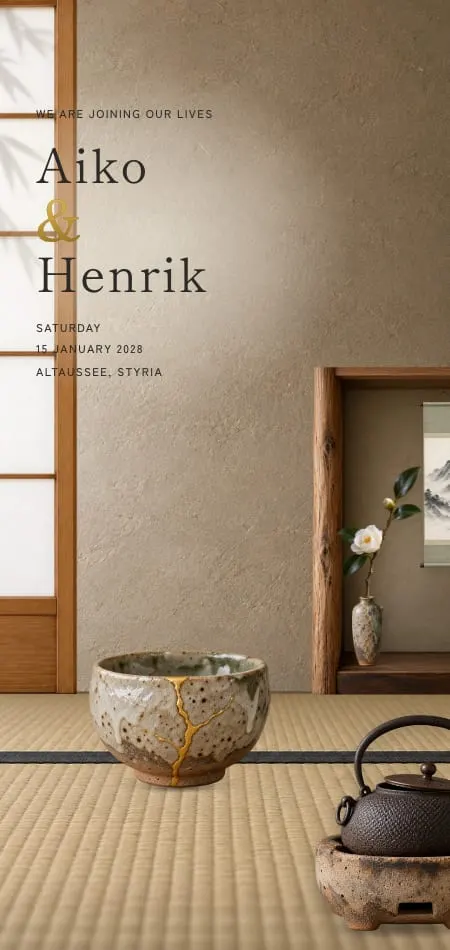
| Japanese | Kintsugi | Gold-mended stoneware | Join the halves | Aiko & Henrik, Altaussee | EN · DE · AR |
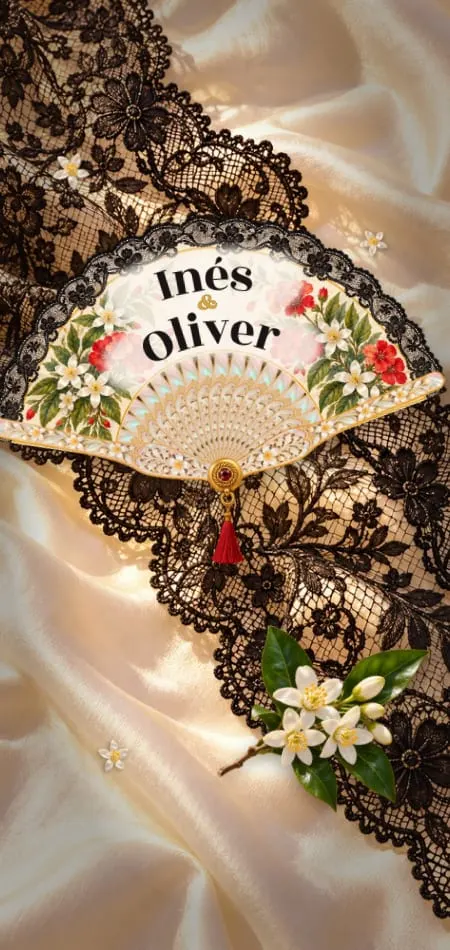
| Andalusian | Éventail | A painted silk fan, a mantilla | Swipe | Inés & Oliver, Seville | EN · ES |
| Venetian | Serenissima | Carnival masks, Murano glass | Lower the mask | Ginevra & Idris, Venice | EN · IT · AR |
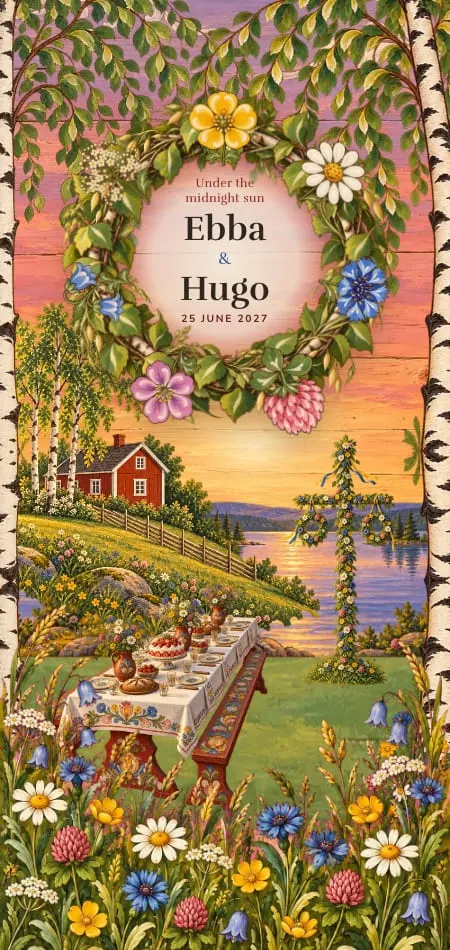
| Swedish | Solstice | Midsummer, Dalarna painting | Turn the maypole | Ebba & Hugo, Dalarna | EN · DE · AR |
| Costa Rican | Selva | A cloud forest, a blue morpho | Tap | Valeria & Tomás, San Gerardo de Dota | EN · ES · AR |
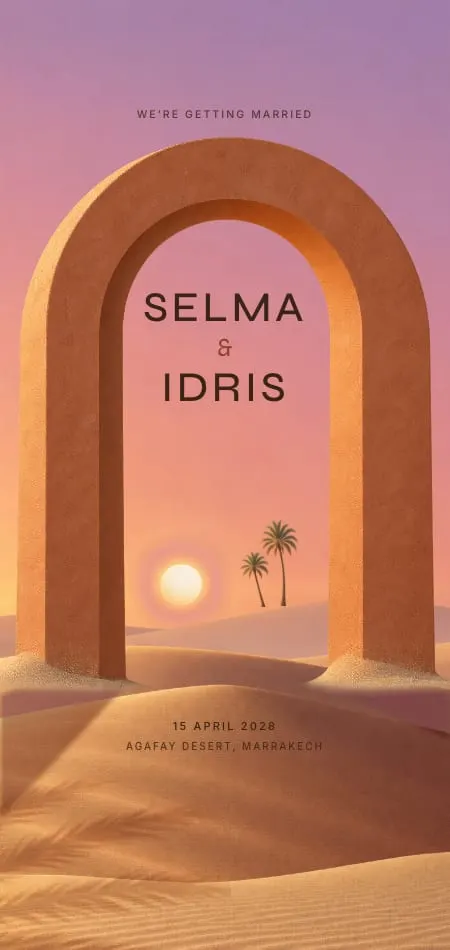
| The desert | Dune | A stone tablet, an arch | Brush the sand | Selma & Idris, Agafay desert | EN · FR · AR |
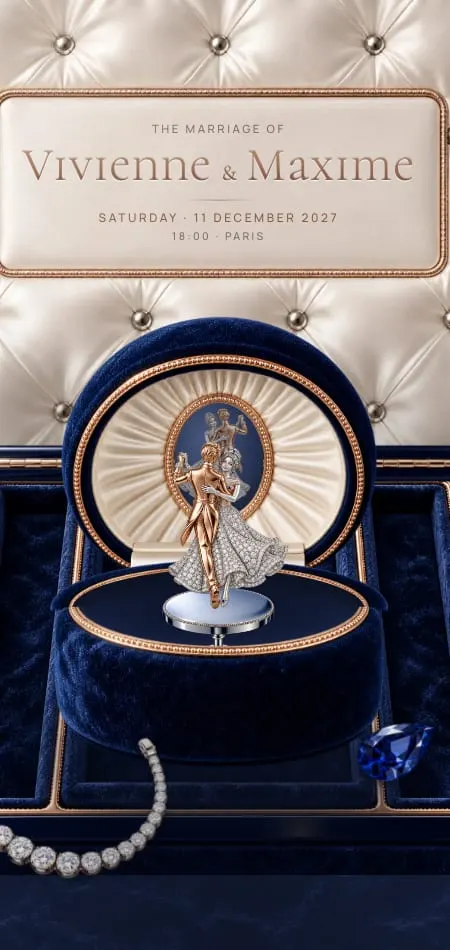
| French | Bulles, Lavande, Carré | Champagne, Provence, silk | Pop, lift, untie | Reims, Provence, Normandy | EN · FR · AR |
| Blue-and-white | Porcelaine | A porcelain cabinet | Tap the tiles | Leonor & Julien, Sintra | EN · ES |
Those are the demo couples' languages; yours can be any.
Moroccan wedding invitation: a riad door (Zellige)
A Moroccan wedding invitation can open the way guests arrive at a riad: at a door. In Zellige, guests knock twice with the brass hand, the cedar doors swing inward and courtyard light floods over a fountain of roses and pierced brass lanterns whose stars of light follow them down every section. A yes pours a glass of mint tea; regrets leave a rose.
What the invitation often needs:
- Languages. Arabic and French are both widely read in Morocco, and Amazigh (Berber) has been an official language since 2011. For script and wording, see Arabic wedding invitations.
- More than one evening. A henna night usually has its own time and place; wedding weekend invitations lays out several days.
- The first words. Many Muslim families open with the Bismillah.
Mexican wedding invitations: papel picado (Hacienda)
A Mexican wedding invitation can carry the fiesta before anyone arrives. Hacienda is painted in gouache and glazed Talavera: at dusk in a town square, guests tap, papel picado unrolls along its cords, the string lights come on and your names are painted on the sky. The date hides under tissue until a cascarón cracks open, and every yes hangs the guest's own flag on the string.
On the invitation:
- Padrinos. Many Mexican invitations name the sponsors of the lazo, the arras or the rings beside the parents. Give them their own section.
- Two places. The Mass and the reception are often at different addresses; give each its own map.
Indian wedding invitations: jaali shutters and mehndi (Jharokha)
An Indian wedding invitation is usually an invitation to several events, so its structure matters as much as its art. Jharokha opens on a Rajasthani palace at dusk: guests swipe carved sandstone jaali shutters hung with marigold and rose, and mehndi draws itself around your names before settling into its deep orange stain. The date hides in a henna mandala, and the day hangs as windows on a marigold thread, each festivity in its own color.
On the invitation:
- Every function with its own date, time, venue and dress code: haldi, mehndi, sangeet, the wedding, the reception, as your families hold them.
- Who is invited to what. If some guests come only to the reception, a separate invitation is clearer than a footnote.
- The opening and the hosts. Many Hindu families begin with an invocation to Ganesha, and Sikh, Muslim, Jain and Christian families have their own; parents, often grandparents too, are named.
Persian wedding invitation: the rose garden scroll (Golestan)
A Persian wedding invitation often leans on poetry, and Golestan shares its name with a book of it: Saadi's Golestan, "the rose garden", written in 1258. Golestan is painted as a Persian miniature in lapis, shell gold and rose. Guests unroll it tier by tier, fountains rise, a nightingale flies in and your names ink in; the nightingale carries each reply away as a pomegranate splits open.
On the invitation:
- Two moments: the aghd, the ceremony at the sofreh aghd, and the aroosi, the celebration, sometimes on different days.
- A line of verse chosen by the family, often from Hafez or Saadi.
- Farsi, right to left. Veiloria lays out right-to-left languages, Farsi included; as it isn't one of the site's eight built-in languages, you supply the guest-facing words and the atelier sets them.
Japanese wedding invitation: kintsugi and the tea room (Kintsugi)
A Japanese-inspired invitation works best when it borrows a craft's quiet, not a costume. Kintsugi is the art of mending broken pottery with lacquer and gold, treating the repair as part of the object's history. In Kintsugi, guests draw two halves of a tea bowl together, gold runs down the crack, and a quiet tea room appears with your names on the wall.
On the invitation:
- Ask about words. Many Japanese families avoid imi-kotoba at weddings: words of cutting, breaking, parting or repeating. The bowl's story is the mend, but let a Japanese relative read your wording.
- A simple reply. Where a paper set would hold a reply card, the reply inside the invitation asks each guest's name and dietary needs.
Spanish wedding invitation: the Andalusian painted fan (Éventail)
For Seville or a Spanish patio, Éventail opens like a fan in the hand. In Éventail, one swipe opens a hand-painted silk fan on a black lace mantilla, your names appear across the silk and orange blossom falls. Castanets count down to the day.
On the invitation: Spanish invitations traditionally name both sets of parents as hosts, a line worth keeping. Name the padrino and madrina in the ceremony section.
Venetian wedding invitation: Carnival and Murano glass (Serenissima)
Serenissima makes Venice at Carnival the opening itself. In Serenissima, guests lower a gilded mask, the Grand Canal comes into focus, a gondola glides in and your names appear in gold leaf. A chandelier lights one arm for each moment of the day.
On the invitation: in Italy a partecipazione announces the wedding, while a separate invito asks guests to the reception, so say plainly who is invited to what; more in destination wedding in Italy.
Swedish wedding invitation: midsummer and the maypole (Solstice)
Solstice paints midsummer the way Dalarna painted its walls, in Falu red and cornflower. In Solstice, guests circle a finger to turn a maypole until eight ribbons stream out, the date is cross-stitched on a linen pillow, and each section gives guests a wildflower for a crown they wear to say yes.
On the invitation: Swedish invitations ask guests to "OSA" (om svar anhålles, the Swedish RSVP) by a date, and many name a toastmaster to contact about speeches. Midsummer is one of Sweden's biggest holidays, so a midsummer-weekend wedding needs an early save the date.
Costa Rican wedding invitation: the cloud forest (Selva)
Selva brings a Costa Rican cloud forest into the invitation. In Selva, guests tap a blue morpho, the fronds part in three layers and a waterfall clearing opens with your names in the mist. The morpho then guides them past a toucan, a sloth and the quetzal.
On the invitation: most guests will travel, so give transfers, weather and a layer to pack for cool mornings. Timelines are in destination wedding invitations.


Desert wedding invitation: where the dunes end (Dune)
Dune belongs to no single culture but to a landscape many share, from Morocco and the Gulf to Rajasthan. In Dune, guests brush the sand off a stone tablet, your names carve themselves into it, and the camera lifts to an arch on a golden dune. As they scroll, the sky runs through one whole day, dawn to stars.
On the invitation: desert days are hot and nights cold, so give exact timings and what to wear.
French wedding invitations: Champagne, Provence and silk (Bulles, Lavande, Carré)
Three French crafts, three openings.
- Bulles: in a Champagne house in the chalk at Reims, guests turn the wire and the cork flies; every reply ends with two glasses clinking.
- Lavande: on a July morning in Provence, guests lift the iron hook and blue shutters swing open on the lavender.
- Carré: guests untie a silk scarf composed for the couple, and its eight cartouches hold the scenes of your day.
On the invitation: a French faire-part announces the wedding, and many couples invite a wider circle to the vin d'honneur (the drinks reception) than to the dinner. Say which each guest is invited to.
Blue-and-white porcelain wedding invitation (Porcelaine)
Blue-and-white porcelain already joins several cultures: it was perfected in 14th-century China at Jingdezhen with cobalt imported from Persia, then imitated from Japan to Delft. In Porcelaine, guests touch a wall of blank glazed tiles that turn over into one painted garden, with your names across a great platter. A teapot pours when a guest accepts.
On the invitation: for a Chinese family, check the palette first. Red and gold are the traditional wedding colors and white can read as mourning, so ask for the colors to be reworked; Premium redesigns any design in your colors.
Multicultural wedding invitations: two cultures, one invitation
Give each culture its own language, its own ceremony and its own symbols, rather than blending them into one motif.
Two languages
On paper, two languages means two columns or two cards. Digitally, each guest can read their own: Veiloria shows every guest their language automatically, with a switch to read the other, and includes 2 languages on Essential, up to 3 on Premium and as many as you need on Bespoke. Have each version written by a native speaker:
Together with their families, Ximena and Karim invite you to celebrate their marriage on Saturday, the seventeenth of April, in San Miguel de Allende.
Junto con sus familias, Ximena y Karim tienen el gusto de invitarlos a celebrar su boda el sábado 17 de abril en San Miguel de Allende.
More patterns are in bilingual wedding invitations.
Two ceremonies
List each ceremony as its own event, with its own time, place, dress code and guests. An example Moroccan–French weekend:
| When | Event | Tradition | Who's invited |
|---|---|---|---|
| Friday evening | Henna night | Moroccan | Close family and friends |
| Saturday, 2 pm | Civil ceremony at the town hall | French (legally first) | Everyone |
| Saturday, 5 pm | Vin d'honneur | French | Everyone |
| Saturday, 8 pm | Dinner and dancing | Both | Dinner guests |
| Sunday, noon | Brunch | Both | Guests staying over |
Symbols from both families
- Ask each family for one symbol, one color and one line of words.
- Give each its own place: one in the opening, one on the cover, one in the reply.
- Check both scripts read correctly.
- Send the final proof to one person from each side.
If no design holds both, a Bespoke invitation begins on a blank page and can start from your families' own symbols. For all 43 designs by theme, see digital wedding invitation ideas.
Sources
- Wikipedia (English), checked 19 October 2026: Gulistan (book), Iranian wedding, Kintsugi, Languages of Morocco, Wedding cord, Blue and white pottery, Marriage in France and Midsummer
- Wikipedia (Swedish), checked 19 October 2026: Om svar anhålles and Toastmaster
Frequently asked questions
How do you combine two cultures on a wedding invitation?
Give each culture its own language, events and symbols rather than merging them into one motif. List each ceremony separately, and have someone from each side read the final proof.
What should an Indian wedding invitation include?
Every function, such as the haldi, mehndi, sangeet, wedding and reception, each with its date, time, venue and dress code. It usually names the hosting parents, often the grandparents too, and many Hindu families open with an invocation to Ganesha.
Can a wedding invitation be in two languages?
Yes. On paper the languages sit side by side or on separate cards; a digital invitation can show each guest their own language automatically. Have each version written by a native speaker rather than translated word for word.
How do you include cultural symbols respectfully?
Let the family choose them, learn what each means, and place sacred marks first. Check colors, since white means mourning in some traditions, and the script of any non-Latin words, then have someone from that tradition approve the proof.
Can an invitation be designed around a specific country or city?
Yes. Several designs start from a place, such as a Marrakech riad, Venice at Carnival or a Costa Rican cloud forest, and Premium paints your real venue on the cover. For a place the collection doesn't hold, a Bespoke invitation is designed from a blank page.