Multilingual weddings16 min read
Bilingual Wedding Invitations: The Complete Guide (2026)
Layouts, which language goes first, translating names and dates, right-to-left scripts, three or more languages, and how each guest can read the whole invitation in their own.
By The Veiloria AtelierPublished Updated
Contents
- How to make a bilingual wedding invitation: the short answer
- Three ways to lay out a bilingual invitation
- Paper vs digital: what changes with two languages
- Which language goes first on a bilingual wedding invitation?
- How to translate a wedding invitation
- Right-to-left scripts: Arabic, Hebrew, Farsi, Urdu
- Multilingual wedding invitations: three or more languages
- What each guest sees: their language first, with a switch
- How many languages each plan includes
- Bilingual save the dates and RSVPs
- A bilingual invitation checklist
- Keep reading
- Sources
- Frequently asked questions
Bilingual wedding invitations carry the same invitation in two languages, so both families can read every word. On paper, the two languages share the page, side by side or stacked, with the hosts' language or the majority's first; on a digital invitation, each guest can open the whole invitation in their own language and switch with a touch.
Below: layouts, language order, translation, right-to-left scripts, three or more languages, and the save the date and RSVP. For ready-to-copy text in each language pair, see our bilingual wedding invitation wording examples.
How to make a bilingual wedding invitation: the short answer
A bilingual wedding invitation is one invitation written in two languages, with the same names, date, venue and reply details in both. A multilingual wedding invitation does the same in three or more.
More than 1 in 5 people aged 5 and older in the United States (22%) spoke a language other than English at home between 2017 and 2021, according to the US Census Bureau (released June 2025).
The process, start to finish:
- List your guests by the language they read most comfortably, not the one they speak at the table.
- Choose your languages. Two covers most weddings; a third often comes from friends or the wedding's country.
- Choose a layout: side by side, stacked, or one language per guest (below).
- Decide which language goes first, using the table further down.
- Write the invitation once, in the language you think in.
- Have it translated by meaning, not word for word, with dates and times in each language's format.
- Ask a native reader from each family to check the final text, on the real layout.
Three ways to lay out a bilingual invitation
Side by side
The two languages sit in two columns, or on facing panels of a folded card.
It suits formal invitations and pairs that read in opposite directions: with English and Hebrew or Arabic, the right-to-left text sits on the right. Its weakness is width: German and Spanish usually run longer than English, so the type shrinks or the card widens.
Stacked
One language sits above the other, divided by a fine rule or an ornament. It is the easiest layout to typeset. The catch is hierarchy: the language on top reads as the main one, so it helps to set the shared facts (names, date, venue) once in larger type and stack only the sentences.
One language per guest
Each guest receives the invitation in their own language. On paper, that means separate print runs and tracking who gets which. On a digital invitation it is the natural layout: one design, one link, each guest reading their own language from the first word to the reply.
| Layout | Paper | Digital | Best for |
|---|---|---|---|
| Side by side | Two columns or facing panels; elegant, but each language gets half the width | Rarely used: phone screens are too narrow for two columns | Formal suites; right-to-left plus left-to-right pairs on paper |
| Stacked | One language above the other; simple to print, the top one reads as "first" | Works, but doubles the scrolling | Short wording; two closely related languages |
| One language per guest | Separate print runs and a careful mailing list | The whole invitation in each guest's language, with a switch | Mixed families, three or more languages, destination weddings |
Paper vs digital: what changes with two languages
On paper, two languages compete for space; on a digital invitation, each language gets the whole invitation.
| Printed bilingual invitation | Digital bilingual invitation | |
|---|---|---|
| Space | Shared: each language gets half the card | Each language gets every section |
| How much you can say | Names, date, venue and reply; details move to inserts | Program, travel, dress code, gifts and RSVP in every language |
| A third language | Crowded; often a separate insert | Same layout as two |
| A mistake after printing | A reprint | Corrected on the same link |
| Right-to-left scripts | The typesetter must know the script | The whole layout should mirror for that language |
| Replies | A reply card in both languages, returned by post | Each guest replies in their own language |
Paper still has its place: a letterpress card in two scripts is a beautiful object, and some couples print a small run for the relatives who will frame it. Our guide to digital wedding invitations explains what a digital one includes, and our comparison of digital wedding invitation sites shows which handle more than one language.
Which language goes first on a bilingual wedding invitation?
Lead with the language of the hosts, or of most guests when the couple hosts together. If the families are evenly split, lead with the language of the country where the wedding takes place, or use a side-by-side layout so neither language comes "first".
"First" means the left column in a side-by-side layout, the top block when stacked, and, on a digital invitation, the language a guest sees when their phone is set to a language the invitation doesn't include.
| Your situation | Lead with | Why |
|---|---|---|
| One set of parents is hosting | The hosts' language | Traditionally, the hosts are the ones inviting |
| You two host, and most guests share one language | The majority's language | Most readers find their words at once |
| The families are evenly split | The language of the wedding's country, or side by side | Neutral, and matches the venue's own language |
| A destination wedding with guests from home | Your guests' language | The local language matters to the venue, not the guests |
| A religious ceremony in Hebrew or Arabic | That language, on the right-hand panel | It reads right to left and carries the ceremony |
| Elderly relatives read only one language | Their language | A small courtesy they will notice |
| A digital invitation | The language most other guests can read (often English) | It is the fallback for anyone whose phone is set to another language |
Whatever you choose, keep the order the same on every piece: save the date, invitation, details card and reply.
How to translate a wedding invitation
A good bilingual invitation reads as if it were written in each language, not translated into it.
Not word for word
Formal invitation phrases are idioms, and idioms don't survive literal translation. Write each line the way that language writes invitations.
| English line | The literal trap | What the other language usually says |
|---|---|---|
| "Request the honor of your presence" | Spanish solicitan el honor de su presencia (stiff, odd) | Spanish tienen el honor de invitarles |
| "Together with their families" | French ensemble avec leurs familles (clumsy) | French Entourés de leurs familles, … ont la joie de vous inviter à leur mariage |
| "Reception to follow" | German Empfang folgt (reads like a notice) | German Anschließend feiern wir gemeinsam |
| "Kindly reply by May 1" | Spanish Amablemente responda (machine-made) | Spanish Se ruega confirmar asistencia antes del 1 de mayo (S.R.C.) |
| "Save the date" | Spanish salva la fecha (a calque) | Spanish reserva la fecha |
Formality is the other trap. English has one "you"; Spanish, French, German, Italian and Portuguese have a formal and an informal one. Choose one register per language (Spanish usted or tú, French vous or tu, German Sie or du) and keep it all the way to the reply. Our wedding invitation wording guide has full wordings by host and tone.
Names, dates and times in each language
Names stay identical; dates and times follow each language's own format.
Never translate given names: Guillermo stays Guillermo in the English text, and Catherine doesn't become Catalina in the Spanish one. Keep each family's naming customs, such as both surnames in Spanish (Lucía Fernández Ortiz), and keep each language's name order: Chinese, Japanese, Korean and Hungarian put the family name first.
Numeric dates are the most common bilingual mistake. 06/12/2027 is June 12 in the United States and 6 December almost everywhere else, so always write the month as a word. Here is the same moment, written the local way:
| Language | Date | Time |
|---|---|---|
| English (US) | Saturday, June 12, 2027 | 4:30 p.m. |
| English (UK) | Saturday 12 June 2027 | 4.30pm |
| Spanish | sábado, 12 de junio de 2027 | 16:30 h |
| French | samedi 12 juin 2027 | 16 h 30 |
| German | Samstag, 12. Juni 2027 | 16:30 Uhr |
| Italian | sabato 12 giugno 2027 | ore 16:30 |
| Portuguese | sábado, 12 de junho de 2027 | 16h30 |
| Dutch | zaterdag 12 juni 2027 | 16.30 uur |
| Arabic (Gulf, Egypt) | السبت ١٢ يونيو ٢٠٢٧ | الساعة ٤:٣٠ عصرًا |
Write the address the way local mail does (in Germany, Spain, Italy and the Netherlands the house number follows the street), and give times in the venue's time zone.
Who should check it
A native speaker from each family should read the final text, on the final layout. Not a draft in an email: the real card, or the invitation on a phone.
Machine translation is a fine first draft and a poor final one: it misses register and drops accents. Ask your readers to check:
- Every name, spelled exactly as its owner spells it, with accents
- The date, and that the weekday matches it
- The time, the venue name and the address
- The level of formality, the same from start to finish
- Titles and honorifics (Mr. and Mrs., Sr. y Sra., M. et Mme)
- The reply-by date and how to reply
Right-to-left scripts: Arabic, Hebrew, Farsi, Urdu
Arabic, Hebrew, Farsi (Persian) and Urdu are written from right to left, and so are Pashto, Yiddish, Dhivehi, Sindhi and Uyghur. Pairing one with English changes the whole layout, not just the words.
The layout mirrors
In a right-to-left language, the page mirrors: text aligns right, columns read right to left, and arrows and "next" buttons point the other way. Photographs, logos and monograms don't flip.
On paper, an Arabic or Hebrew booklet opens from what an English reader calls the back. On a digital invitation, the whole page should switch direction when the language changes, as the W3C's guidance on right-to-left text in HTML describes. A page that only right-aligns Arabic, without changing direction, puts punctuation at the wrong end of the line.
Arabic also changes the grammar: the couple is two people, so Arabic uses the dual form (يتشرفان, حفل زفافهما), which English lacks and machine translation often misses.
Numbers and dates
Digits inside right-to-left text still run left to right, so mixed lines need care:
- Which digits. Much of the Gulf, Egypt and the Levant write Arabic-Indic digits (١٢ يونيو), while Morocco, Algeria and Tunisia write Western digits (12 يونيو). Farsi and Urdu use their own forms of several digits.
- Which month names. يونيو is used in Egypt and the Gulf; Levantine Arabic says حزيران, and Algeria and Tunisia say جوان. Use the one the family uses.
- A second calendar. Many Muslim families add the Hijri date, Jewish invitations often give the Hebrew date beside the civil one, and Iranian families may add the Solar Hijri date. Ask the family rather than converting it yourself.
- Mixed lines. Phone numbers with a plus sign, house numbers and English venue names inside an Arabic sentence can display in the wrong order. The Unicode Bidirectional Algorithm decides how they render; check them on a real phone.
Names in two scripts
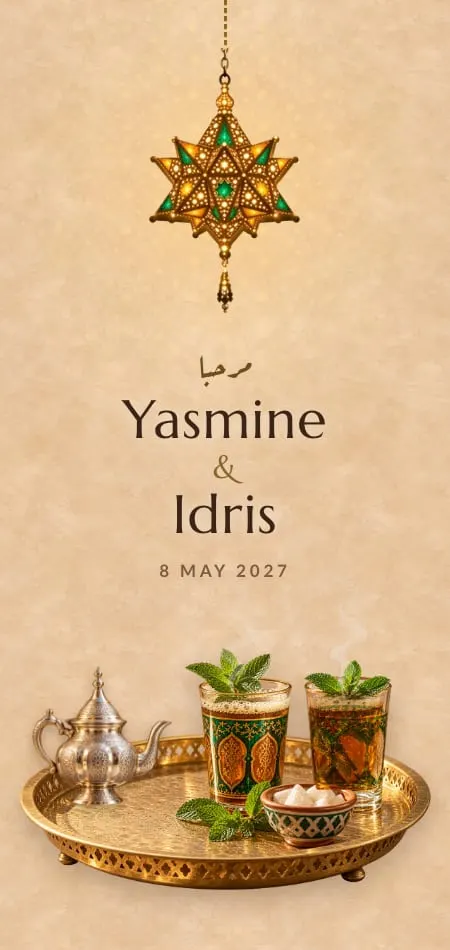
Agree on one spelling of each name in each script, and use it everywhere. Thomas becomes توماس in Arabic; Yasmine becomes ياسمين. Where a name has several spellings (Mohammed, Muhammad, Mohamed), follow the person's own.
The opening lines of an English and Arabic invitation, for a couple who host it themselves:
| English | Arabic |
|---|---|
| Lucía and Thomas | لوسيا وتوماس |
| invite you to celebrate their wedding | يتشرفان بدعوتكم لحضور حفل زفافهما |
| Saturday, June 12, 2027, at seven in the evening | وذلك يوم السبت ١٢ يونيو ٢٠٢٧ الساعة السابعة مساءً |
| Kindly reply by May 1 | يرجى تأكيد الحضور قبل ١ مايو |
Treat it as a starting point for a native reader. Many Muslim families open with the Basmala (بسم الله الرحمن الرحيم) or a verse, and our guide to Arabic wedding invitations covers those openings in depth. For other faiths, see our religious wedding invitation wording.
Multilingual wedding invitations: three or more languages
Yes, a wedding invitation can be in three languages or more; on paper it gets crowded, while a digital invitation handles three as easily as two.
On paper, three languages mean narrow columns and small type. There are three usual fixes:
- Shared facts once, sentences three times. Names, date and venue in large type at the center; the short sentences around them in each language.
- One language per card. The main card in the hosts' language, with an insert for each of the others.
- Separate print runs. One version per language, matched to each household on the mailing list.
On a digital invitation, a third language is one more version of the same design: 30 of our 43 demos are written in three. Families with roots in several countries, as in our guide to cultural wedding invitations, are where three languages matter most.
What each guest sees: their language first, with a switch
On a bilingual digital wedding invitation done well, each guest reads the whole invitation in their own language without choosing anything, and can switch with one touch. This is how a Veiloria invitation works:
- It reads the guest's phone. The invitation checks the languages set on the guest's phone or browser, in order of preference, and opens in the first one it is written in. A Portuguese guest opening a French and Portuguese invitation reads it in Portuguese.
- It falls back to your first language. A guest whose phone is set to Japanese, opening an invitation in Spanish and English, sees your first language.
- There is a switch. A small switch in the corner (EN · FR · AR) changes the language with one touch.
- Right-to-left languages mirror. In Arabic, Hebrew, Farsi, Urdu and the other right-to-left languages, the reading order and layout mirror, not only the text, while photographs and logos stay as they are. Arabic invitations address the couple in the dual.
- Any language in the world. The guest-facing words (the reply buttons, the countdown, "Joyfully accepts") are built in for English, Spanish, French, German, Italian, Portuguese, Dutch and Arabic. For any other language, your designer adds them with your help.
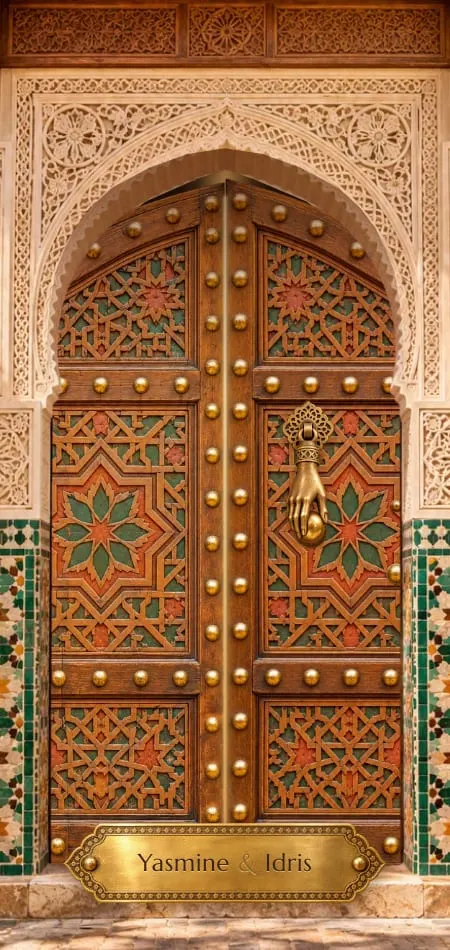
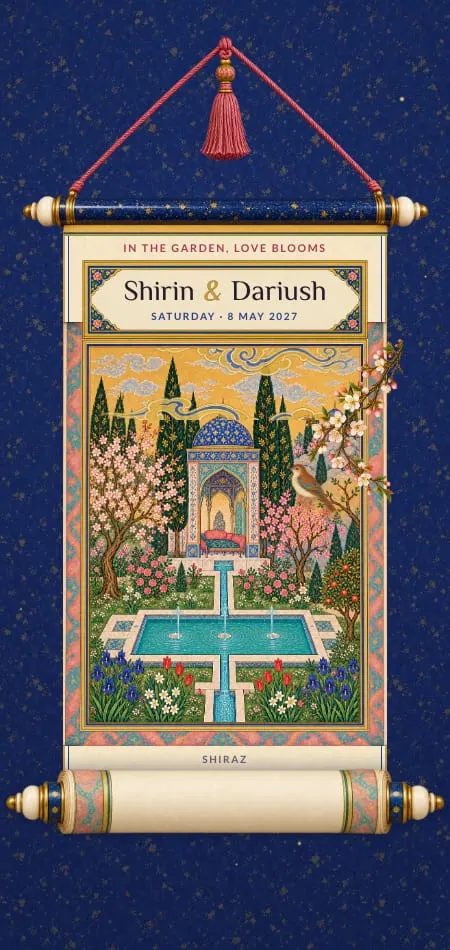
Our demo couple Yasmine and Idris wrote their Zellige invitation in English, French and Arabic: open it, knock twice on the riad door, then switch languages and watch the page turn around for Arabic.
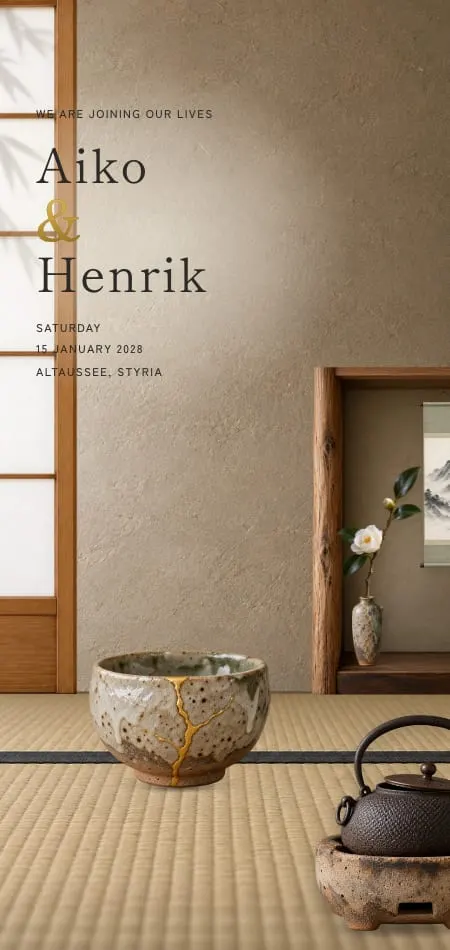
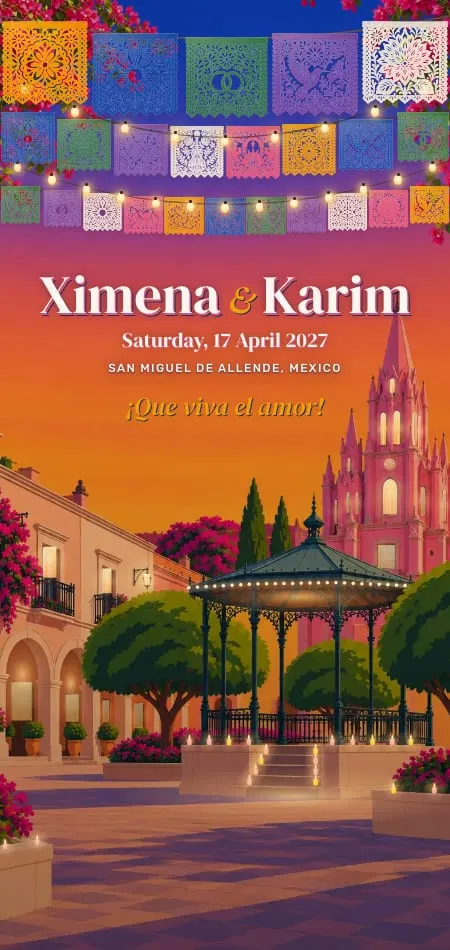
Or open it straight in Arabic. More trilingual demo couples: Orangerie (English, Spanish, Arabic), Kintsugi (English, German, Arabic), Golestan (English, Arabic, French) and Hacienda, which puts Spanish first.

How many languages each plan includes
Every Veiloria plan is bilingual at least: Essential includes 2 languages, Premium up to 3, and Bespoke as many as you need. A Save the Date ordered on its own includes 2.
| Plan | Languages | One-time price (USD) | Also good to know |
|---|---|---|---|
| Essential | 2 | $199 | A design from the collection, personalized with your names and details |
| Premium | Up to 3 | $599 | Redesigned around your wedding; matching Save the Date included |
| Bespoke | As many as you need | $999 | Begun on a blank page, with your own designer |
| Save the Date on its own | 2 | $79 | Any two languages in the world |
Prices are one payment per wedding (or the equivalent in your currency), with unlimited guests and no per-guest fees. Four or five languages? That is Bespoke. See the full comparison of plans:
The three plans
One payment per wedding.
One-time payment
The design
- Design
- From the collection, as is
- Redesigned in your style
- 100% bespoke, from scratch
- Personalisation
- Your details and photos
- Custom icons and illustrations
- Fully bespoke
- Venue illustration
- Optional · +$55
- Included, painted by hand
- Included, exclusive
- Monogram
- Optional · +$29
- Included
- Included, bespoke
- Animated cover & music
- Optional · from +$19
- Included
- Included, original edit
- Art direction
- —
- —
- Editorial
Working with your designer
- Your designer
- Contact after ordering
- Dedicated to your wedding
- Dedicated, priority replies
- Design revisions
- 2 rounds
- 4 rounds
- 7 rounds
- Ready in
- 7–14 days
- 7–14 days
- Your own schedule
- Express delivery
- 1–4 days · +$99
- 1–4 days · +$99
- Not available
For you and your guests
- Languages
- 2 included
- Up to 3
- As many as you need
- Save the Date
- Optional · +$79
- Included free
- Included, bespoke
- Guest list
- Optional · +$65
- Included
- Included
- Invitation for another event
- Optional · +$55
- Optional · +$55
- Optional · +$55
- Your own domain
- Optional · +$75
- Optional · +$75
- Included
On every plan
- RSVP
- Information · Unlimited, editable anytime
- Sends to guests · Unlimited
- Envelope with your initials
Choose Premium for a third language or your venue painted on the cover; our guide to luxury digital wedding invitations explains that redesign.
Bilingual save the dates and RSVPs
Save the date. It needs only names, date, place and "formal invitation to follow", so it is the easiest piece to make bilingual, in the same languages and order as the invitation. It goes out 6–12 months before the wedding, or 9–12 months for a destination wedding; our guide to when to send wedding invitations has the full timeline. Choose a digital save the date in the same design as the invitation, so guests recognize it when the invitation arrives.
RSVP. The reply is where translation mistakes cost you: a guest who doesn't understand "plus one" or "dietary requirements" leaves them blank. On a digital invitation, each guest replies in the language they are reading, and every reply lands in one list. Our guide to digital wedding invitations with RSVP covers the questions worth asking.
The message you send with the link. Write it in both languages, in one message:
Hello everyone! Our wedding invitation is here, in English and Spanish: it opens in your phone's language, and you can switch with one tap. Please reply by May 1. 💌 [link]
¡Hola a todos! Ya está aquí nuestra invitación de boda, en español e inglés: se abre en el idioma de vuestro móvil y podéis cambiarlo con un toque. Por favor, confirmad vuestra asistencia antes del 1 de mayo. [enlace]
For weddings abroad, our guide to destination wedding invitations covers travel details, timing and the local language. For a wedding in Italy, our guide to a destination wedding in Italy has the timeline and wording in English and Italian.
A bilingual invitation checklist
- Every guest has a language, and you know who reads only one.
- The languages and their order are the same on every piece.
- Each name is spelled identically in every language, with accents.
- Each script has one agreed spelling of each name.
- Dates are written with the month as a word, in each language's format.
- Times follow each language's format, in the venue's time zone.
- The formality (formal or informal "you") is consistent in each language.
- Right-to-left text reads correctly, including numbers, phone numbers and venue names.
- The reply questions are clear in every language.
- A native reader from each family has checked the final version.
Keep reading
- Bilingual wedding invitation wording, by language pair
- Arabic wedding invitations
- Destination wedding invitations
- Planning a destination wedding in Italy
- Common questions about invitations and languages
Sources
- US Census Bureau, "2017–2021 American Community Survey language use tables", released June 3, 2025; checked October 19, 2026.
- W3C Internationalization, "Structural markup and right-to-left text in HTML"; checked October 19, 2026.
- Unicode Consortium, "Unicode Bidirectional Algorithm (UAX #9)"; checked October 19, 2026.
Frequently asked questions
How do you make a bilingual wedding invitation?
Write the invitation once in the language you think in, then have it translated by meaning, not word for word. Choose a layout (side by side, stacked, or one language per guest) and which language goes first. Before sending, ask a native speaker from each family to read the final version.
Which language goes first on a bilingual wedding invitation?
The hosts' language goes first, or the language most guests read when you two host together. If the families are evenly split, lead with the language of the country where you marry, or set the two side by side so neither comes first.
Can a wedding invitation be in three languages?
Yes. On paper, put the shared facts once in large type with short sentences in each language, or add an insert per language. On a digital invitation, each guest reads the whole invitation in their own language, so three are as simple as two.
Should you translate names on a bilingual invitation?
No. Names stay exactly as their owners spell them in every language, accents included, so Guillermo stays Guillermo in the English text. The only change is between scripts: for Arabic, Hebrew, Greek or Cyrillic, agree on one spelling in that script and use it on every piece.
How do you write a wedding invitation in Arabic and English?
Write the Arabic as Arabic, not as a translation: it reads right to left, addresses the couple in the dual and often opens with the Basmala. On paper, set the Arabic on the right; on a digital invitation, the whole layout should mirror in Arabic. Agree on each name's Arabic spelling, use the digits the family writes, and have a native reader check it.
Can each guest read the invitation in their own language?
Yes, on a digital invitation. A Veiloria invitation opens in the language set on the guest's phone when it is one of the invitation's languages, falls back to your first language otherwise, and has a switch for changing language with a touch. Try it on the Zellige demo, written in English, French and Arabic.