Multilingual weddings14 min read
Arabic Wedding Invitations: Wording, Design and Etiquette
The family's voice, verses and poetry, men's and women's invitations, the milka, right-to-left design and privacy, with 12 Arabic and Arabic–English wordings to copy.
By The Veiloria AtelierPublished Updated
Contents
- What goes on Arabic wedding invitations: the short answer
- Who invites: the family's voice
- Arabic wedding invitation wording: 8 formal examples
- Arabic and English wedding invitations (4 examples)
- Separate invitations for men and women
- Milka and aqd qiran: the contract ceremony invitation
- Right-to-left design that feels native
- Privacy: photographs, names and private links
- Addressing the couple: the dual
- Customs in the Gulf, the Levant, Egypt and the Maghreb, briefly
- Sources
- Frequently asked questions
Arabic wedding invitations are usually issued in the family's name, open with the Basmala, a Quranic verse or a line of poetry, and are written in formal Modern Standard Arabic. In much of the Gulf, men and women receive separate invitations, the marriage contract (the milka) often has its own, and many families leave the bride's name and photographs off.
Arabic is used daily by more than 400 million people (UNESCO, checked October 19, 2026), and its invitations vary from Rabat to Muscat. Below are 12 wordings to copy and the design, privacy and regional choices around them; for two languages, pair this with our complete guide to bilingual wedding invitations.
What goes on Arabic wedding invitations: the short answer
An Arabic wedding invitation is a formal announcement, usually in the family's voice, that asks guests to a wedding, a marriage contract or both, written right to left in Modern Standard Arabic. Families who speak a dialect at home still write it in فصحى (fusha), which reads as respectful everywhere.
From top to bottom, a traditional one holds:
- An opening: بسم الله الرحمن الرحيم (the Basmala, "In the name of God, the Most Gracious, the Most Merciful"), a verse or a line of poetry.
- The host: the groom's father, both fathers, both sets of parents, or the couple.
- The invitation: يتشرف بدعوتكم ("has the honor of inviting you").
- The couple: the groom's name, and the bride's name or a phrase that stands for it.
- The date: often the Hijri date, then الموافق ("corresponding to") and the Gregorian one.
- The time: a clock time, or after a prayer: بعد صلاة العشاء ("after the night prayer").
- The venue, then a closing line of courtesy.
- Notes: children, photography and a reply-by date.
Who invites: the family's voice
In most Arab families, the parents invite, not the couple: a wedding joins two families, and the first line says so.
Invitations from the father or both families
In Saudi Arabia and much of the Gulf, the classic invitation comes from the groom's father, to the wedding of "his son", with the bride's father named below; some families name both fathers. In the Levant and Egypt, both sets of parents often sign, with وعقيلته ("and his wife") after each father's name.
A grammar point that trips up translators: when the verb comes first, it stays singular even with two hosts: يتشرف عبدالله الراشد وسعد الحمدان. When the names come first, the verb takes the dual: عبدالله الراشد وسعد الحمدان يتشرفان.
The couple's names, and when the bride's name is left off
Leaving the bride's name off is a long-standing, respected choice in the Gulf, and it is done with a formula, not a blank.
| Formula | Meaning | Where it's used |
|---|---|---|
| على كريمة سعد بن علي الحمدان | "to the daughter of Saad bin Ali Al Hamdan" | Saudi Arabia and the Gulf, men's invitations |
| كريمتهما | "their daughter" | Invitations from both of the bride's parents |
| حرم عبدالله الراشد | "the wife of Abdullah Al Rashid" | Women's invitations, so the mother isn't named either |
| Initials (ف & ن) | The couple's first letters | Modern and bilingual designs |
Some families print her full name only on the women's invitation; many print both names in full. Ask both families before the design starts.
Arabic wedding invitation wording: 8 formal examples
Formal Arabic wording keeps the order above; what changes is the opening, the closing and the grammar of who invites whom.
Opening with Bismillah or a verse
Most Muslim families open with the Basmala alone. Those who add a verse choose one about marriage, set between the ornate brackets ﴿ ﴾ that mark Quranic text in print, with its reference:
| Verse | Reference | Meaning (our rendering) |
|---|---|---|
| وَمِنْ آيَاتِهِ أَنْ خَلَقَ لَكُمْ مِنْ أَنْفُسِكُمْ أَزْوَاجًا لِتَسْكُنُوا إِلَيْهَا وَجَعَلَ بَيْنَكُمْ مَوَدَّةً وَرَحْمَةً ۚ إِنَّ فِي ذَٰلِكَ لَآيَاتٍ لِقَوْمٍ يَتَفَكَّرُونَ | Ar-Rum 30:21 | Among His signs: He created spouses for you from among yourselves, to find rest in them, and placed affection and mercy between you. |
| وَمِنْ كُلِّ شَيْءٍ خَلَقْنَا زَوْجَيْنِ لَعَلَّكُمْ تَذَكَّرُونَ | Adh-Dhariyat 51:49 | Of everything We created pairs, so that you may reflect. |
Ar-Rum 30:21 is the classic choice. Copy it from a printed mushaf or Quran.com, and have someone who reads Quranic Arabic check the proof. Christian families often open with فالذي جمعه الله لا يفرقه إنسان (Matthew 19:6: what God has joined, no one may divide); our religious wedding invitation wording covers other faiths.
Lines of poetry
Poetry (أبيات شعرية) can replace the verse or sit beneath it. Many lines shared online are misattributed, so print a classical line only when you can name its poet. Two lines our atelier wrote for this guide, free to use:
في ليلةٍ يزدانُ فيها الفرحُ بالأحباب، نفتحُ لكم القلوبَ قبل الأبواب
On a night adorned by those we love, we open our hearts to you before our doors.
اجتمع القلبان على المودّة والرحمة، وبحضوركم تتمّ النعمة
Two hearts met in affection and mercy; with you there, the blessing is complete.
The closing
- وبحضوركم يتم لنا الفرح والسرور: "Your presence completes our joy."
- وبتشريفكنّ تكتمل فرحتنا: the same, in the feminine plural, for a women's invitation.
- جنة الأطفال منازلهم: "Children's paradise is their homes", the gentle Gulf way to say adults only.
- نأمل التكرم بعدم التصوير: "We kindly ask that no photographs be taken."
Eight invitations to copy
Names, venues and dates are fictional. Hijri dates follow the Umm al-Qura calendar used in Saudi Arabia.
1. Men's invitation from the groom's father (Saudi Arabia)
بسم الله الرحمن الرحيم
يتشرف عبدالله بن محمد الراشد
بدعوتكم لحضور حفل زواج ابنه
فيصل
على كريمة سعد بن علي الحمدان
وذلك بمشيئة الله مساء يوم الخميس ٥ جمادى الآخرة ١٤٤٩هـ
الموافق ٤ نوفمبر ٢٠٢٧م بعد صلاة العشاء
في قاعة الياسمين، الرياض
وبحضوركم يتم لنا الفرح والسرور
2. Women's invitation from the groom's mother (Saudi Arabia)
بسم الله الرحمن الرحيم
تتشرف حرم عبدالله بن محمد الراشد
بدعوتكنّ لحضور حفل زواج ابنها فيصل
على كريمة سعد بن علي الحمدان
وذلك مساء يوم الخميس ٥ جمادى الآخرة ١٤٤٩هـ الموافق ٤ نوفمبر ٢٠٢٧م
الساعة التاسعة مساءً في قاعة الياسمين، الرياض
وبتشريفكنّ تكتمل فرحتنا
جنة الأطفال منازلهم · نأمل التكرم بعدم التصوير
The mother invites as "the wife of Abdullah", and every verb and pronoun turns feminine plural: بدعوتكنّ، بتشريفكنّ.
3. Both fathers, both names (UAE)
بسم الله الرحمن الرحيم
يتشرف خليفة سالم المهيري وراشد حمد الكعبي
بدعوتكم لحضور حفل زفاف
حمدان وميثاء
وذلك مساء يوم الخميس ٢١ أكتوبر ٢٠٢٧ الساعة الثامنة
في قاعة الريم، أبوظبي
4. Both families, a church wedding (Lebanon)
السيد جورج حداد وعقيلته
والسيد سليم خوري وعقيلته
يتشرفون بدعوتكم لحضور صلاة الإكليل لولديهم
كريم وليال
وذلك في تمام الساعة السادسة من مساء يوم السبت الواقع فيه 17 تموز 2027
في كنيسة مار الياس، جبيل
تقبل التهاني بعد الإكليل في صالون الكنيسة
Syriac month names (تموز, July), Western digits, and congratulations received in the church hall afterward.
5. Contract and celebration on one day (Egypt)
بسم الله الرحمن الرحيم
﴿وَمِنْ كُلِّ شَيْءٍ خَلَقْنَا زَوْجَيْنِ لَعَلَّكُمْ تَذَكَّرُونَ﴾
يتشرف أحمد الشناوي وطارق منصور
بدعوتكم لحضور كتب كتاب وحفل زفاف
عمر وسلمى
يوم الخميس ٧ أكتوبر ٢٠٢٧
عقد القران عقب صلاة المغرب بمسجد الرحمة، والفرح الساعة التاسعة مساءً
بفندق النيل، القاهرة
6. Both parents (Morocco)
بسم الله الرحمن الرحيم
يتشرف السيد محمد بنسودة وحرمه
والسيد عبد الرحيم التازي وحرمه
بدعوتكم لحضور حفل زفاف
مهدي وغيثة
وذلك يوم السبت 25 شتنبر 2027 على الساعة الثامنة مساءً
بقصر النخيل، فاس
وبحضوركم يكتمل فرحنا
Moroccan month names (شتنبر for September) and Western digits.
7. The couple hosting, in the dual (Jordan)
ريم وزياد
يتشرفان بدعوتكم لمشاركتهما ليلة العمر
مساء السبت ١٢ حزيران ٢٠٢٧، الساعة الثامنة
في منتجع الشاطئ، العقبة
يرجى تأكيد الحضور قبل ١ أيار
8. The milka, from the bride's father (Saudi Arabia)
بسم الله الرحمن الرحيم
يتشرف سعد بن علي الحمدان
بدعوتكم لحضور عقد قران كريمته
على فيصل بن عبدالله الراشد
وذلك مساء يوم الخميس ١٥ ربيع الآخر ١٤٤٩هـ الموافق ١٦ سبتمبر ٢٠٢٧م
بعد صلاة المغرب في منزله، الرياض
Arabic and English wedding invitations (4 examples)
In an Arabic and English invitation, write each language the way it writes invitations, not word for word. Give English readers a clock time where the Arabic says "after the night prayer". More pairings are in our bilingual wedding invitation wording examples.
9. Family-voiced, Gulf
يتشرف عبدالله بن محمد الراشد بدعوتكم لحضور حفل زواج ابنه فيصل
مساء الخميس ٤ نوفمبر ٢٠٢٧ بعد صلاة العشاء · قاعة الياسمين، الرياض
Abdullah bin Mohammed Al Rashid
requests the honor of your presence at the wedding of his son, Faisal
Thursday, November 4, 2027, at eight in the evening
Al Yasmin Hall, Riyadh
10. The couple hosting, modern
Reem & Ziad · ريم وزياد
We're getting married, and we'd love you there.
Saturday, June 12, 2027 · 8 p.m. · Aqaba
يتشرفان بدعوتكم لمشاركتهما ليلة العمر
السبت ١٢ حزيران ٢٠٢٧ · الساعة الثامنة مساءً · العقبة
11. A women's evening, for international friends
يسعدنا أن ندعوكنّ لحضور حفل النساء احتفالًا بزواج نورة
مساء الخميس ٢ ديسمبر ٢٠٢٧ الساعة التاسعة · نأمل التكرم بعدم التصوير
You are warmly invited to the ladies' celebration for Noura's wedding
Thursday, December 2, 2027, at nine in the evening
We kindly ask that no photographs be taken.
12. A nikah invitation, small and close
Amira and Yusuf invite you to witness their nikah,
followed by dinner with family
Saturday, May 1, 2027, at 4 p.m. · The family home, Manchester
أميرة ويوسف يتشرفان بدعوتكم لحضور عقد قرانهما
يعقبه عشاء عائلي · السبت ١ مايو ٢٠٢٧ · الساعة الرابعة عصرًا
Nikah (نكاح) is the word many South Asian and Western Muslim families use for the marriage contract.
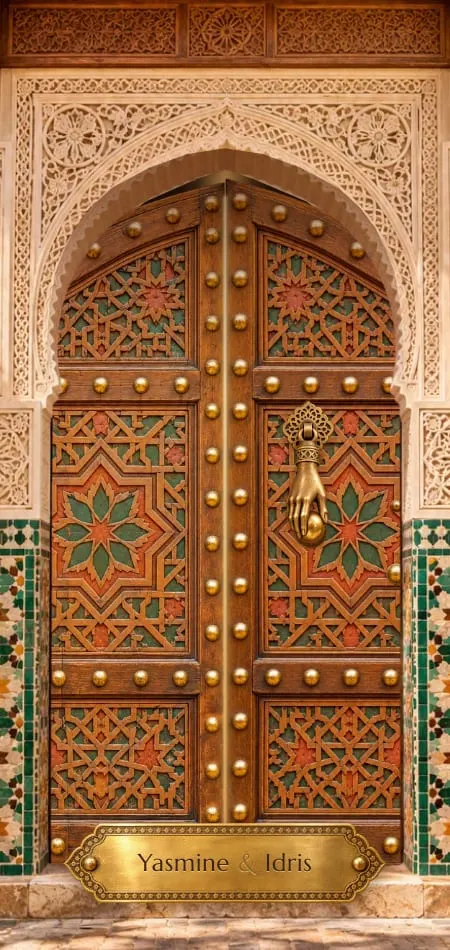
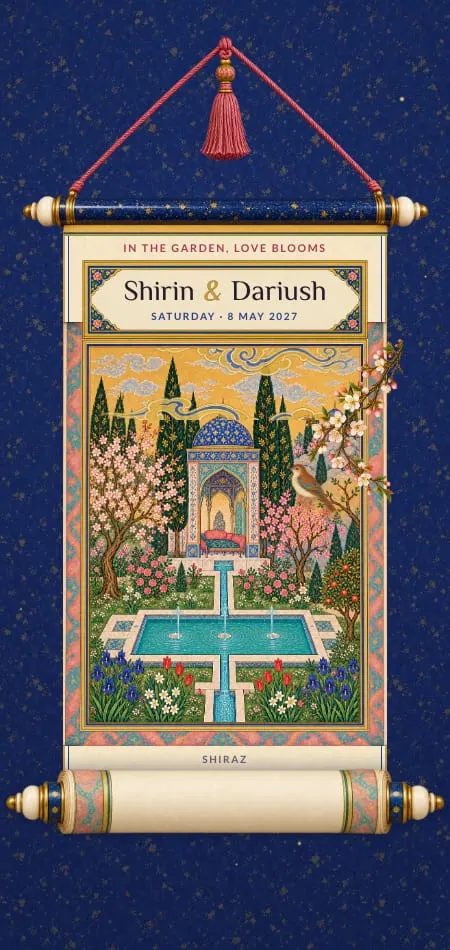
Each of these designs has an Arabic demo, written by its demo couple in three languages:

Separate invitations for men and women
In Saudi Arabia and much of the Gulf, men's and women's celebrations are often held separately, so each gets its own invitation with its own wording, time and sometimes venue. It is a family custom, not a rule: many weddings across the Arab world are mixed.
| Men's invitation | Women's invitation | |
|---|---|---|
| Issued by | The groom's father, or both fathers | The groom's mother, often as حرم ("wife of") |
| Addresses guests as | بدعوتكم (masculine plural) | بدعوتكنّ (feminine plural) |
| The bride's name | Often a formula (على كريمة…) | More often printed in full |
| Typical notes | The time after the night prayer | No photography, adults only |
| Sent to | Men of both families and friends | Women of both families and friends |
Keep one design, so both sides recognize the same wedding, and two guest lists, so nobody receives the wrong version.
With Veiloria, the second version is a matching invitation for another event, +$55 on every plan (or the equivalent in your currency): the same design, with its own wording, time and venue. Our guide to evening reception and separate-guest invitations covers splitting a guest list without offense.
Milka and aqd qiran: the contract ceremony invitation
A milka invitation asks close family to the signing of the marriage contract, which in Saudi Arabia is called the milka (ملكة) and elsewhere aqd qiran (عقد القران) or katb el-kitab (كتب الكتاب). In the Gulf it is often held at the bride's family home, sometimes weeks or months before the wedding celebration. In Egypt it is often held in a mosque, sometimes on the wedding day itself.
Each event can have its own invitation:
| Event | What happens | Who's invited | The invitation |
|---|---|---|---|
| Milka / aqd qiran | The contract is signed before witnesses | Close family | Short, from the bride's father (example 8) |
| Henna night (ليلة الحناء) | Henna, music and the bride's family | Women, close friends | Informal, often a message |
| Men's celebration | Dinner, often with traditional dances | Men of both families | Formal, family-voiced (example 1) |
| Women's celebration | The bride's entrance (الزفة), music | Women of both families | Formal, feminine plural (example 2) |
| Walima (وليمة) | The wedding feast | Both families, friends | Often merged with the celebration |
When events stretch over days, see our guide to wedding weekend invitations.
Right-to-left design that feels native
An Arabic invitation should be designed right to left from the first sketch, not flipped from an English one. A mirrored layout shows at once: ornaments facing the wrong way, cramped Arabic, numbers out of order.
A layout designed for Arabic, not mirrored
| Turns around for Arabic | Stays as it is |
|---|---|
| Text alignment and reading order | Photographs |
| Arrows, "next" and swipe directions | Monograms and Latin initials |
| Asymmetric ornaments and borders | Phone numbers and clock times, which read left to right |
| The order of columns and sections | Maps |
Arabic typography
Naskh "has become the default form of Arabic in most contexts", and Thuluth leads in calligraphic art, according to the W3C's Arabic and Persian layout requirements.
| Script | Character | Best for |
|---|---|---|
| Naskh (نسخ) | Clear, balanced | Body text, dates, venues |
| Thuluth (ثلث) | Tall, sweeping, ceremonial | The Basmala, a verse, the names |
| Diwani (ديواني) | Ornate, interlaced | Names on very formal invitations |
| Kufi (كوفي) | Geometric, angular | Monograms, modern designs |
Three rules set luxury digital wedding invitations apart from quick ones: never letter-space Arabic, because its letters join; never fake italics; and set Arabic slightly larger than the Latin beside it.
Western or Eastern Arabic numerals
Use the digits and month names of the family's country. The W3C calls 0–9 "European numerals" and ٠–٩ "Arabic-Indic numerals" to avoid confusion.
| Region | Digits | September in Arabic |
|---|---|---|
| Gulf and Egypt | Often ٠١٢٣٤٥٦٧٨٩ | سبتمبر |
| Levant and Iraq | Both | أيلول |
| Morocco | 0123456789 | شتنبر |
| Algeria and Tunisia | 0123456789 | سبتمبر (and جوان for June) |
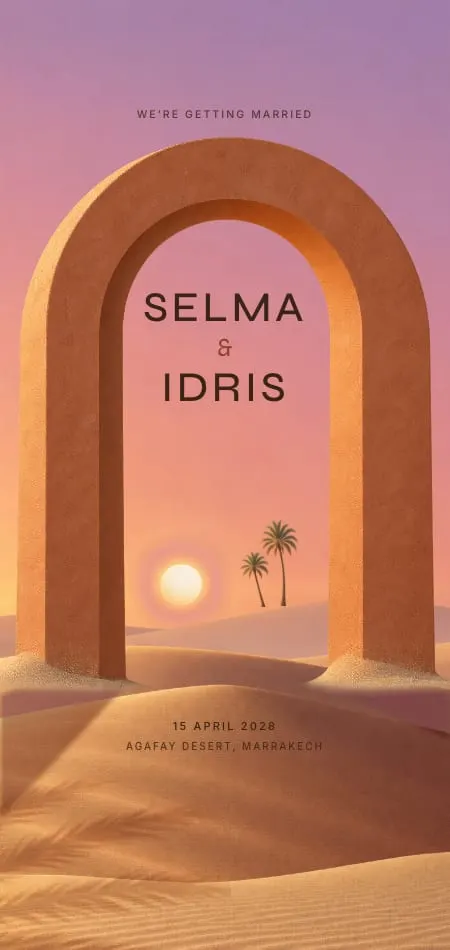
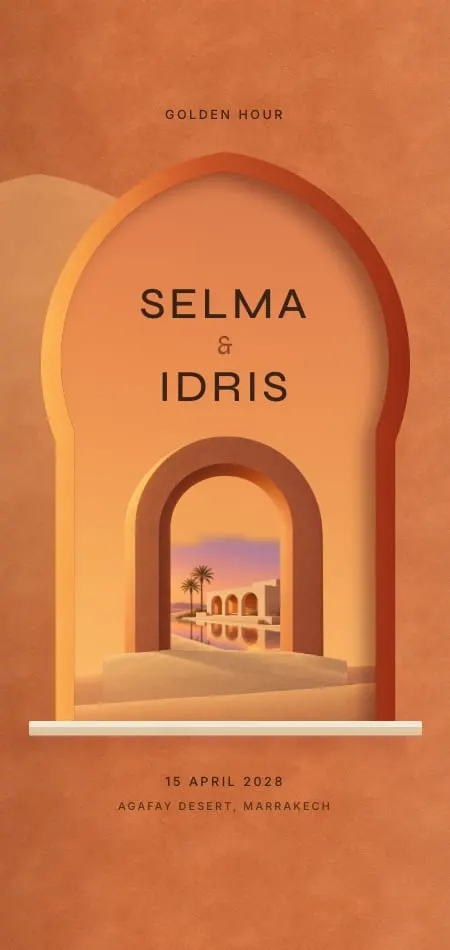
On Veiloria, an Arabic invitation turns the whole page right to left, its reply buttons and countdown are in Arabic, and it addresses the two of you in the dual. Our demo couple Selma and Idris wrote their Dune digital wedding invitation in English, French and Arabic: brush the sand off the tablet, switch to Arabic and watch the page turn around. Veiloria in Arabic reads right to left too; our FAQ covers languages.
Privacy: photographs, names and private links
A digital invitation keeps a family's privacy when it lives on a private link, carries only the names and photographs the family chooses, and reaches only the guests on the list. Many Gulf families show no photographs, or show them only on the women's version.
- Decide on names first: full names, a formula, or initials.
- Choose photographs, or none: a pattern or a monogram can hold the cover.
- Send personal links that greet each guest by name, so a forwarded invitation is easy to spot.
- Ask guests, in the wording, not to photograph the women's celebration.
- Know what your QR code does. In the Gulf, "barcode invitations" often mean entry passes scanned at the door; a code that opens an invitation is not one. See our guide to wedding invitation QR codes.
On a Veiloria invitation, photographs appear only if you send them, and nothing is shared until you approve the proof.
Addressing the couple: the dual
Arabic has a dual form for exactly two people, so the couple is addressed as أنتما ("you two") and spoken of as هما, and every verb and pronoun about them takes the dual. Machine translation often misses it.
| Plural (wrong for the couple) | Dual (right) | Meaning |
|---|---|---|
| يتشرفون بدعوتكم | يتشرفان بدعوتكم | They are honored to invite you |
| حفل زفافهم | حفل زفافهما | Their wedding |
| ألف مبروك لكم | ألف مبروك لكما | Congratulations to you both |
The Prophet Muhammad's prayer for a newlywed speaks to the groom in the singular, then to the two of them in the dual: بَارَكَ اللَّهُ لَكَ وَبَارَكَ عَلَيْكَ وَجَمَعَ بَيْنَكُمَا فِي خَيْرٍ (Sunan Abi Dawud 2130; Jami' at-Tirmidhi 1091). On invitations and cards it is often put in the dual throughout: بارك الله لكما وبارك عليكما وجمع بينكما في خير.
Customs in the Gulf, the Levant, Egypt and the Maghreb, briefly
Arabic invitations share a language, not a template: each region has its own words, dates and customs. A starting point, to check with both families, since many mix regions:
| Gulf | Levant | Egypt | Maghreb | |
|---|---|---|---|---|
| The wedding is called | زواج, زفاف | عرس, زفاف | فرح | عرس |
| The contract | ملكة, عقد قران | كتب الكتاب | كتب الكتاب | عقد القران |
| Men and women | Often separate | Usually mixed | Usually mixed | Usually mixed |
| Dates | Hijri and Gregorian | Gregorian, Syriac months | Gregorian | Gregorian, local months |
| Second language | Often English | French or English | English | French |
| Worth knowing | Thursday night is a traditional wedding night | Christian families invite to صلاة الإكليل | The katb el-kitab is often held in a mosque | Henna night, and several outfit changes for the bride |
Sources
All checked October 19, 2026.
- UNESCO, "World Arabic Language Day".
- W3C, "Arabic & Persian Layout Requirements".
- The Quran, Ar-Rum 30:21 and Adh-Dhariyat 51:49, Arabic text as published by Quran.com.
- Sunan Abi Dawud, hadith 2130, and Jami' at-Tirmidhi, hadith 1091.
- Hijri dates converted with the Umm al-Qura calendar through the Aladhan calendar API.
Frequently asked questions
How do you word an Arabic wedding invitation?
Follow the formal order: the Basmala or a verse, the host, يتشرف بدعوتكم ("has the honor of inviting you"), the couple, the date, time and venue, and a closing line. Write it in Modern Standard Arabic, with the couple in the dual and a women's invitation in the feminine plural.
Which verse is used on a Muslim wedding invitation?
Ar-Rum 30:21 is the classic choice: spouses created to find rest in each other, with affection and mercy between them. Adh-Dhariyat 51:49 is also used, and many families print the Basmala alone. Quote the verse exactly, between ﴿ ﴾, with its reference.
Should men and women get separate wedding invitations?
Only if the celebrations are separate, which is common in Saudi Arabia and much of the Gulf and much rarer elsewhere. Each invitation then has its own wording, time and guest list in the same design, and the women's version uses the feminine plural.
What is a milka invitation?
A milka invitation asks guests to the signing of the marriage contract, which Saudi families call the milka (ملكة) and others aqd qiran or katb el-kitab. It is short, usually sent by the bride's father to close family, and in the Gulf it can come weeks or months before the wedding.
Can an invitation be in Arabic and English at the same time?
Yes. On paper, the Arabic sits on the right and the English on the left, or the two are stacked. On a digital invitation, each guest can read the whole invitation in their own language, the Arabic laid out right to left.
Can you leave the bride's name off the invitation?
Yes, and in the Gulf it is a common, respected choice. Families use a formula instead, such as على كريمة followed by her father's name ("to the daughter of…"), or initials, and some print her name only on the women's invitation.